Chloroquine diphosphate Chloroquine assay by VA-SFDF-LPME coupled to GC-MS biofluid analysis
Copy code to add this image to your page
Quantitative monitoring of therapeutic agents in biological matrices remains crucial for evaluating clinical pharmacokinetics and therapeutic drug monitoring. Chloroquine diphosphate, an aminoquinoline derivative historically utilized as an antimalarial agent, has garnered significant investigation regarding its activity against SARS-CoV-2 and endosomal trafficking processes. Accurate determination of Chloroquine concentrations in complex biological fluids such as serum, urine, and saliva presents substantial analytical challenges due to matrix interference, low analyte abundance, and complex protein binding profiles. Conventional chromatographic procedures frequently require extensive sample prep steps, high solvent consumption, and multi-stage solid-phase extraction protocols that increase analytical variability.
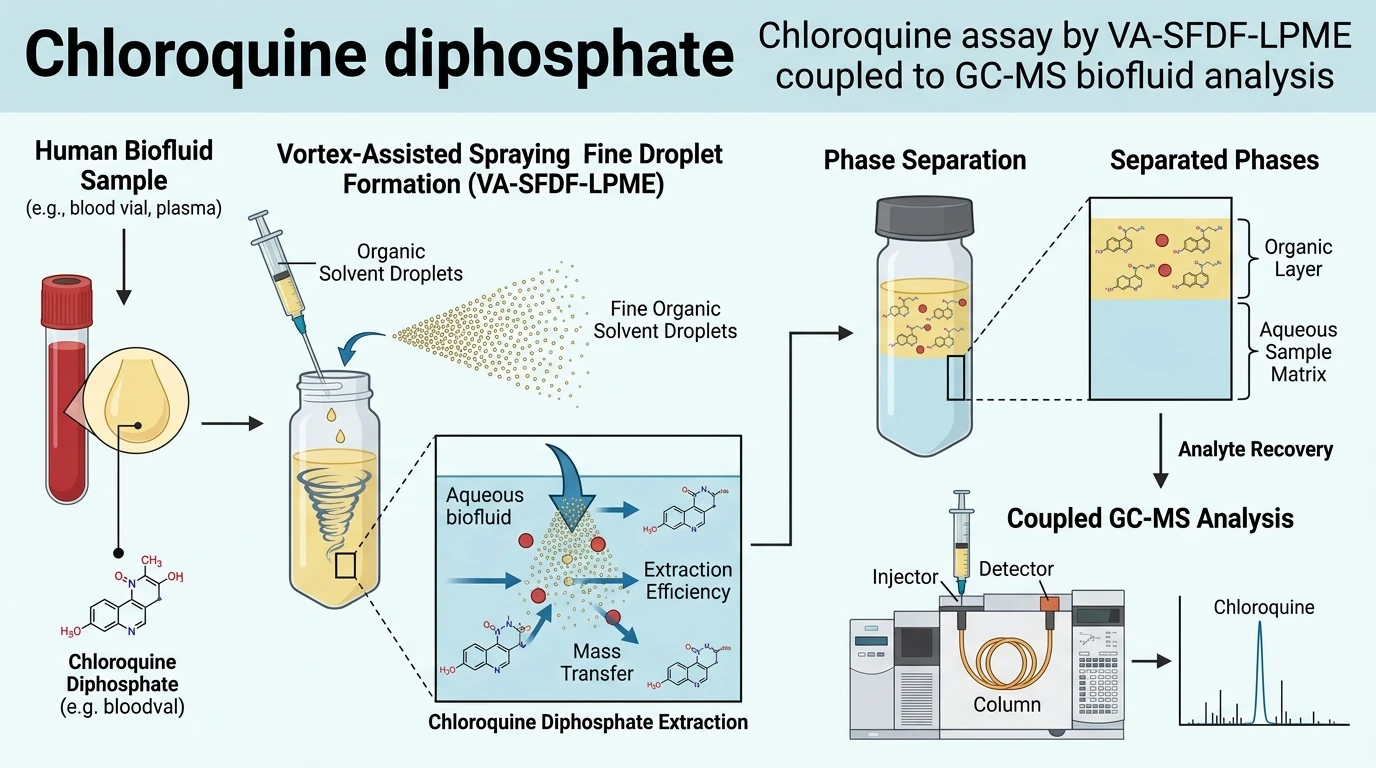
To address these limitations, a vortex-assisted spraying-based fine droplet formation liquid phase microextraction (VA-SFDF-LPME) approach was developed in combination with gas chromatography-mass spectrometry (GC-MS). This sample preparation strategy relies on fine droplet formation to maximize the surface-area-to-volume ratio between the organic extraction solvent and the aqueous biological matrix. Spraying dichloromethane into the sample solution under alkaline conditions rapidly disperses microscopic droplets throughout the bulk phase. Subsequent vortex mixing facilitates rapid mass transfer across the liquid-liquid interface, achieving equilibrium within seconds without requiring prolonged heating or complex phase separation hardware.
Systematic optimization of the VA-SFDF-LPME parameters established optimal extraction efficiency. An initial sample volume of 12.0 mL was combined with 0.75 mL of 60 g/kg sodium hydroxide to ensure complete deprotonation of the aminoquinoline core, converting the drug into its lipophilic neutral form. Two discrete sprays of dichloromethane provided an optimal solvent micro-volume for target partitioning while minimizing organic waste. A brief 15-second vortexing period provided sufficient mechanical energy to sustain transient emulsion states without causing irrecoverable phase emulsification.
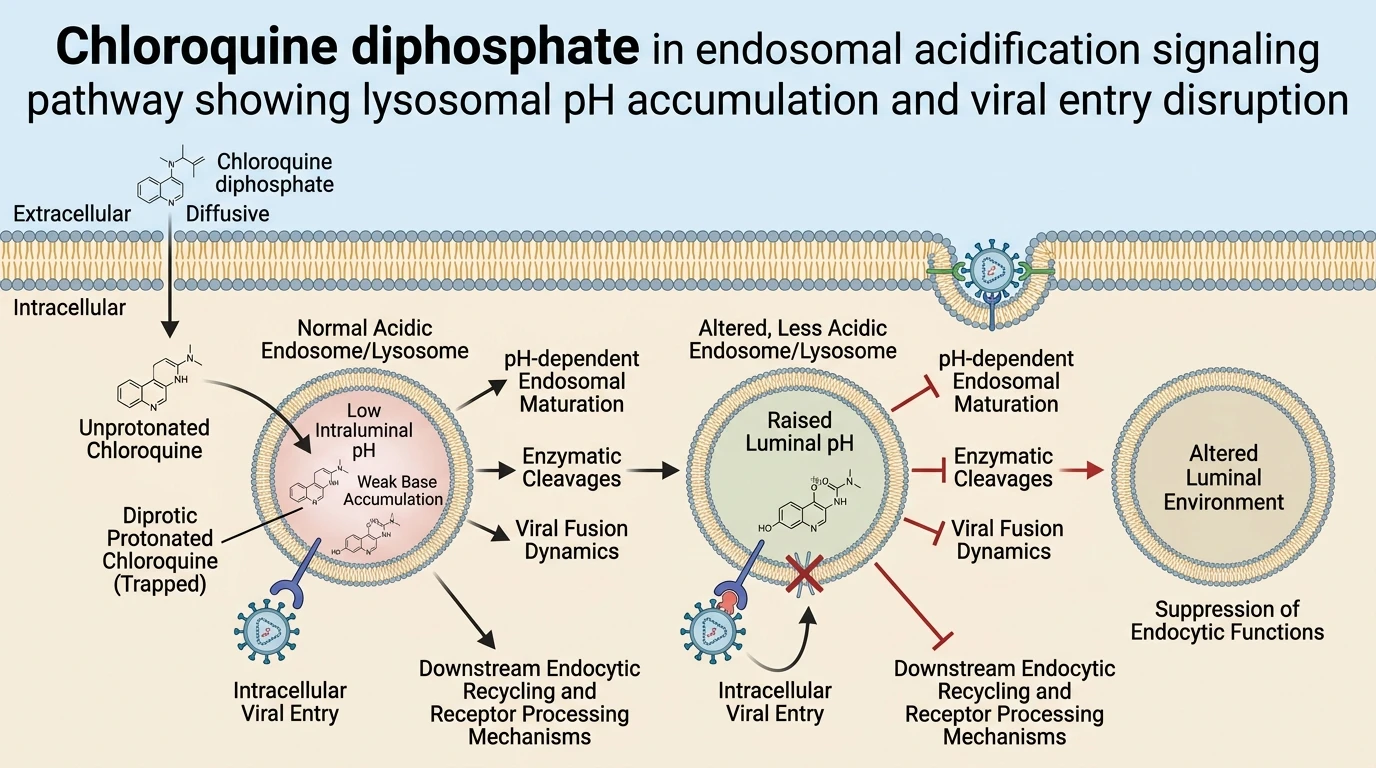
The optimized VA-SFDF-LPME-GC-MS assay yielded a limit of detection (LOD) of 2.8 μg/kg and a limit of quantification (LOQ) of 9.2 μg/kg in complex human biofluids. This analytical protocol yielded a 317-fold enhancement in detection sensitivity relative to direct GC-MS analysis without preconcentration. Validation across spiked human serum, urine, and saliva matrices produced recoveries ranging between 90.9% and 114.0% with acceptable relative standard deviations. Mechanistically, altered cellular transport and host response dynamics can be contextualized within broader cell cycle regulatory pathways that govern cellular susceptibility and therapeutic responsiveness. The high recovery metrics and extreme sensitivity enhancement establish VA-SFDF-LPME as a robust method for routine clinical monitoring of Chloroquine in translational and diagnostic workflows.
Methodological Optimization and Biofluid Extraction Performance
Copy code to add this image to your page
The VA-SFDF-LPME analytical methodology isolates Chloroquine phosphate from serum, urine, and saliva by forming fine organic solvent droplets under alkaline conditions. Spraying dichloromethane into a 12.0 mL sample treated with sodium hydroxide maximizes the contact surface area. A 15-second vortex agitation promotes rapid partitioning into the organic phase. Subsequent GC-MS analysis provides high-sensitivity detection with a 317-fold signal enhancement over direct injection, achieving sub-microgram quantification boundaries in biological specimens.
Fine Droplet Dispersion Accelerates Extraction Kinetics
Fine droplet generation governs mass transfer rates in liquid-phase microextraction. Rapid dispersion of dichloromethane creates an expanded interfacial surface area. Mass transfer equilibrium occurs within seconds. In this optimization framework, two discrete solvent sprays achieved uniform fine droplet distribution throughout the 12.0 mL aqueous sample. Alkaline pH adjustment using 0.75 mL of 60 g/kg sodium hydroxide was required to deprotonate the target molecule completely. Neutralization of the tertiary amine groups enhances solvent partitioning into the organic phase. Vortex agitation for 15 seconds provided adequate kinetic energy without forming persistent biofluid emulsions. The rapid extraction timeline significantly reduces overall sample preparation duration while maintaining analytical throughput.
Biofluid Recovery Metrics Confirm Analytical Precision
Matrix effects frequently impair quantitative fidelity in biofluid assays. Serum, urine, and saliva present distinct viscosity and protein challenges. High baseline noise typically masks low analyte concentrations. In spiked human biofluids, the VA-SFDF-LPME protocol achieved mean Chloroquine recoveries between 90.9% and 114.0%. The technique generated a 317-fold preconcentration factor compared to direct chromatographic injection. Lower limits of quantification reached 9.2 μg/kg across tested matrices. Precision remained within acceptable regulatory guidelines across multiple validation runs. These empirical findings confirm that fine droplet microextraction efficiently eliminates protein interferences while preserving target analyte recovery.