Beclin Inhibitors
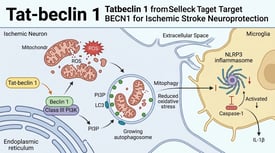
Beclin-1 is a central scaffold protein in the autophagy pathway, playing a pivotal role in the initiation and regulation of the autophagosome formation process. It functions primarily as part of the Class III phosphatidylinositol 3-kinase (PI3K) complex, which includes VPS34, VPS15, and ATG14. This complex is responsible for the production of phosphatidylinositol 3-phosphate (PI3P), a lipid signaling molecule essential for the recruitment of other autophagy-related (ATG) proteins to the pre-autophagosomal structure. Beclin-1 activity is tightly regulated through its interaction with various binding partners, most notably the anti-apoptotic protein Bcl-2. When Bcl-2 is bound to the BH3 domain of Beclin-1, autophagy is inhibited; conversely, the dissociation of this complex triggers the autophagic process.
Given its central role, Beclin-1 is implicated in a wide range of diseases. In cancer, its role is context-dependent: it can act as a tumor suppressor by maintaining genomic stability and preventing the accumulation of damaged organelles, but it can also promote the survival of established tumors under metabolic stress or during chemotherapy. Additionally, Beclin-1 is involved in neurodegenerative diseases like Alzheimer’s and Parkinson’s, where impaired autophagy leads to the accumulation of toxic protein aggregates, and in viral infections, where it can either facilitate or inhibit viral replication. The development of Beclin-1 inhibitors has focused on disrupting its ability to promote autophagy in contexts where the process is detrimental, such as in advanced cancer or certain viral infections. One of the most well-known inhibitors is Spautin-1 (Specific and Potent Autophagy Inhibitor-1), which does not bind Beclin-1 directly but promotes the degradation of the Beclin-1-VPS34 complex by inhibiting the deubiquitinating enzymes USP10 and USP13.
This leads to the proteasomal degradation of Beclin-1 and the subsequent inhibition of autophagy. Other research efforts have focused on small molecules and peptides that mimic the BH3 domain of Bcl-2 to stabilize the Beclin-1-Bcl-2 interaction, thereby keeping Beclin-1 in an inactive state. Current research is largely in the preclinical stage, with studies exploring the use of Beclin-1 inhibitors to sensitize cancer cells to radiation and traditional chemotherapy. Inhibitors are generally classified into direct binders, complex destabilizers, and indirect modulators of Beclin-1 expression. A significant challenge in this field is the dual nature of autophagy; inhibiting Beclin-1 might kill tumor cells but could also lead to unwanted side effects by disrupting normal cellular homeostasis in healthy tissues.
Furthermore, the high degree of homology between the BH3 domains of various proteins makes achieving high selectivity a difficult task. Future research is directed toward developing more specific small molecules and exploring the therapeutic potential of modulating Beclin-1 in combination with other targeted therapies to fine-tune the autophagic response.