Navitoclax (ABT-263) Bcl-2 inhibitor Sensitizes Ovarian Cancer Cells via BCL2L2 Synthetic Lethality
Copy code to add this image to your page
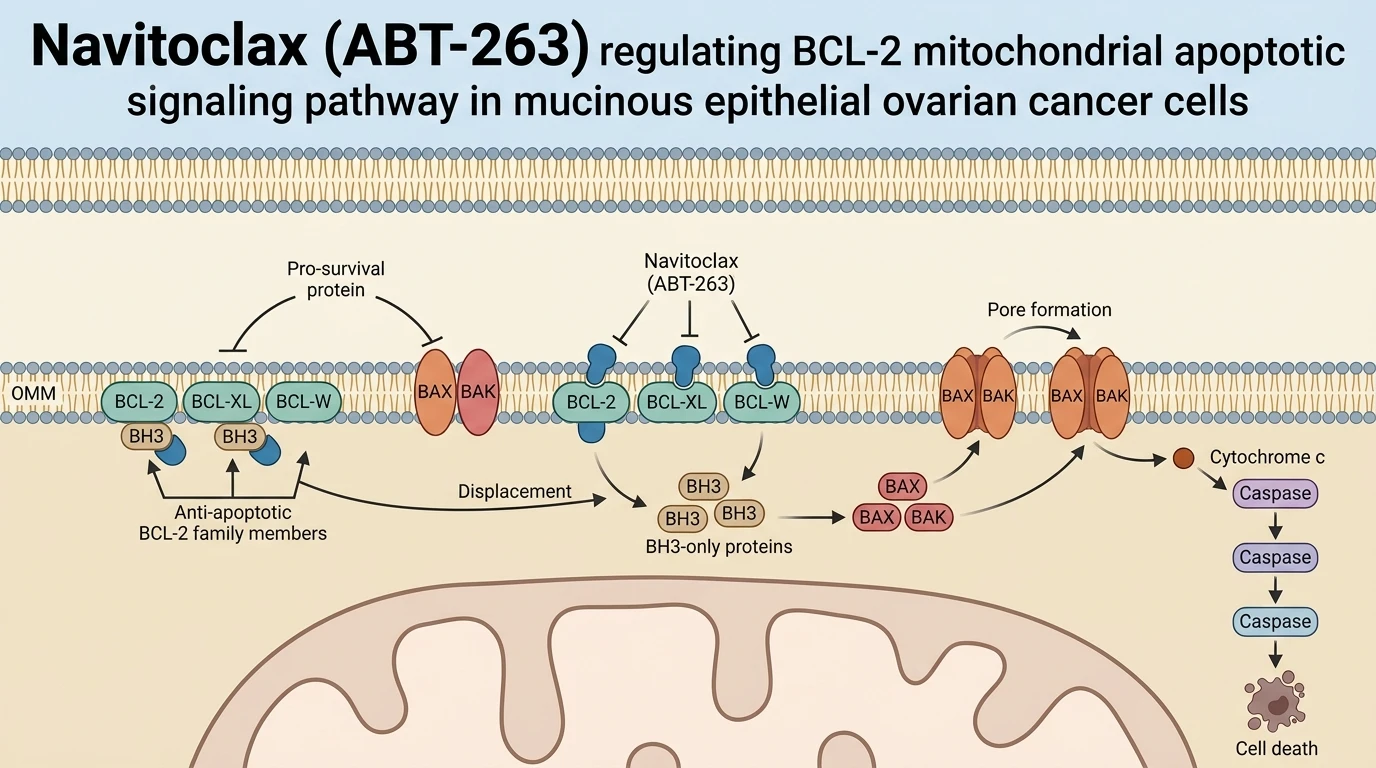
Evading apoptosis represents a primary hallmark of mucinous epithelial ovarian cancer (mEOC), a distinct and chemoresistant histological subtype. Mitochondrial outer membrane permeabilization (MOMP) serves as an irreversible commitment step toward programmed cell death, strictly governed by interaction networks among BCL-2 family proteins. Pro-survival family members—primarily BCL-2, BCL-XL, and BCL-W (encoded by BCL2L2)—exert anti-apoptotic activity by sequestering pro-apoptotic BH3-only proteins and preventing the activation of effectors BAX and BAK. In mEOC models, persistent upregulation of these pro-survival factors dampens intrinsic apoptotic signaling, driving resistance to conventional cytotoxic chemotherapy.
Navitoclax (ABT-263) is a small-molecule, orally bioavailable pan-BCL-2 family inhibitor designed to mimic the binding motif of BH3-only proteins. By occupying the hydrophobic binding grooves of BCL-2, BCL-XL, and BCL-W, Navitoclax disrupts their interactions with pro-apoptotic partners. As a target-directed small molecule inhibitor, the Navitoclax (ABT-263) Bcl-2 inhibitor reinstates latent apoptotic sensitivity within malignant cells, driving mitochondrial cytochrome c release and subsequent activation of initiator and executioner caspases.
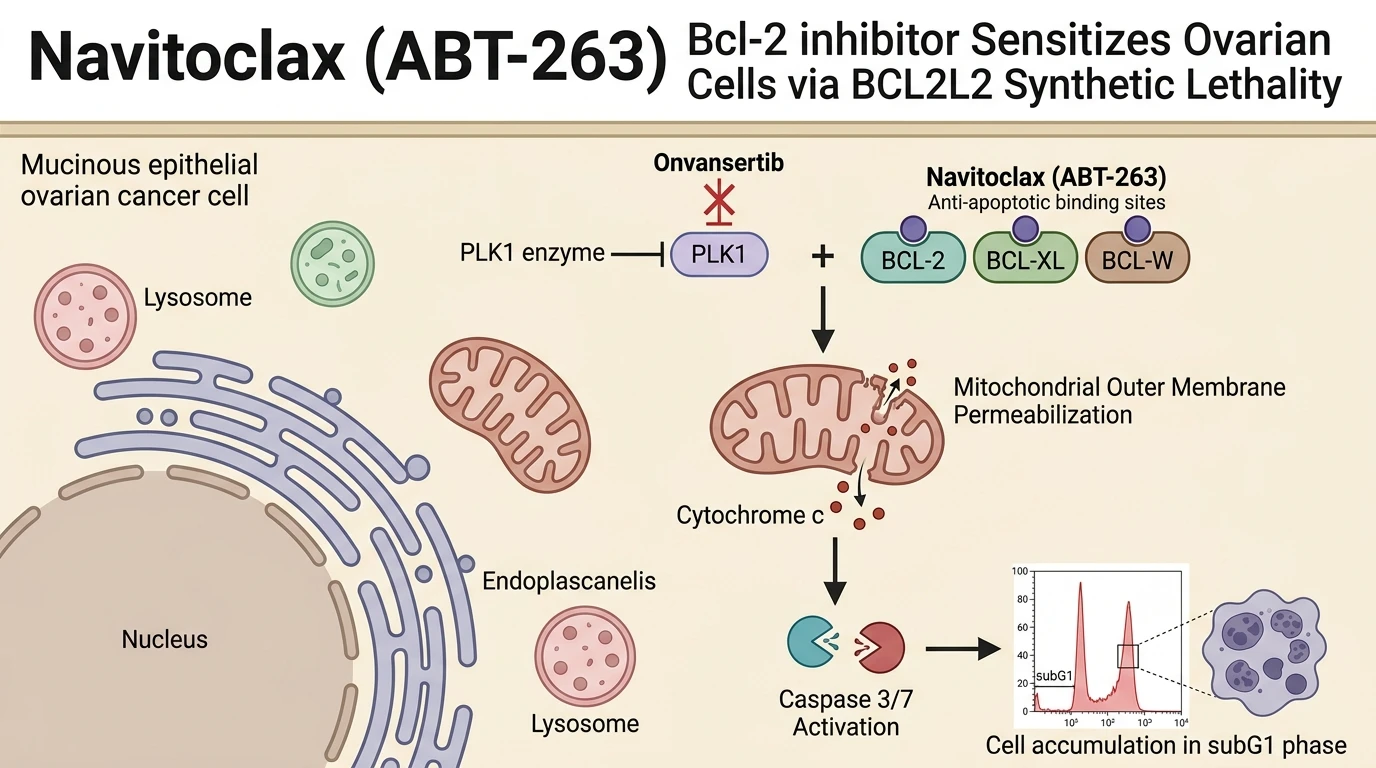
To identify functional vulnerabilities downstream of cell cycle dysregulation in mEOC, high-throughput CRISPR/Cas9 loss-of-function screens were conducted in combination with targeted therapy. Screening data identified BCL2L2 (encoding BCL-W) as a critical genetic determinant of survival during Polo-like kinase 1 (PLK1) inhibition using the clinical candidate onvansertib. Genetic knockout of BCL2L2 markedly enhanced cell sensitivity to PLK1 disruption. This synthetic lethal interaction was validated pharmacologically using Navitoclax (ABT-263) across multiple mEOC cell lines, including EFO27, OCM.72, TOV2414, and MCAS. Dual target engagement produced synergistic cytotoxic responses rather than additive effects.
Mechanistic evaluations in vitro showed that co-treatment with Navitoclax and onvansertib induced profound apoptosis within 24 to 48 hours of exposure. Synergistic target engagement altered key cell cycle dynamics, marked by a substantial accumulation of cells in the subG1 phase. This subG1 population expansion reflects widespread genomic fragmentation downstream of executioner caspase activity. In these experimental contexts, neither PLK1 inhibition nor selective BCL-2 neutralization alone achieved equivalent levels of cell death at sub-micromolar concentrations. Co-inhibition appears to overcome functional redundancies among pro-survival BCL-2 members, preventing adaptive escape mechanisms. These empirical findings demonstrate that co-targeting mitochondrial anti-apoptotic buffer capacity alongside mitotic kinase function presents a rational therapeutic approach for mEOC, though clinical efficacy and therapeutic windows require validation in prospective patient-derived xenograft assays.
Pharmacological Synergism and Synthetic Lethal Mechanisms in Ovarian Cancer
Copy code to add this image to your page
Navitoclax (ABT-263) functions as an orally bioavailable inhibitor of anti-apoptotic BCL-2 family proteins, targeting BCL-2, BCL-XL, and BCL-W (BCL2L2). By blocking the hydrophobic binding grooves of these pro-survival factors, Navitoclax liberates BH3-only pro-apoptotic proteins, driving mitochondrial membrane permeabilization and executioner caspase activation. In mucinous epithelial ovarian cancer cells, combining Navitoclax with the PLK1 inhibitor onvansertib exploits a functional synthetic lethality. Dual inhibition triggers pronounced cell death via apoptosis and significant subG1 cell cycle arrest, providing a strategic dual-targeting framework to overcome anti-apoptotic therapy resistance in mEOC.
Identification of BCL2L2 Vulnerability Under PLK1 Kinase Inhibition
High-throughput functional genomic screening uncovered a pronounced synthetic lethal interaction between PLK1 inhibition and BCL2L2 loss in mucinous epithelial ovarian cancer models. Disruption of PLK1 activity by onvansertib induces mitotic arrest. However, single-agent PLK1 suppression frequently fails to commit tumor cells to mitochondrial apoptosis due to compensatory buffering by anti-apoptotic BCL-2 family proteins. Pharmacological target engagement using the Navitoclax (ABT-263) Bcl-2 inhibitor directly addresses this anti-apoptotic buffer. Small-molecule co-inhibition antagonizes BCL-2, BCL-XL, and BCL-W simultaneously. Cellular viability dropped sharply following combination treatment across all tested cell lines. The synthetic interaction proved consistent in EFO27, OCM.72, TOV2414, and MCAS models under controlled assay conditions.
Induction of Apoptotic Cascades and SubG1 Genomic Accumulation
Dual disruption of mitotic homeostasis and anti-apoptotic defense triggers rapid mitochondrial membrane breakdown. Flow cytometric analysis revealed marked accumulation of the subG1 cellular fraction within 48 hours of co-treatment. SubG1 elevation directly correlates with cleavage of executioner caspases 3 and 7. The single-agent treatments elicited modest subG1 shifts at equivalent doses. In contrast, simultaneous application of the Navitoclax (ABT-263) Bcl-2 inhibitor with onvansertib yielded a synergistic, non-additive expansion of apoptotic cells. These observed cell death kinetics highlight a critical dependency on pro-survival BCL-2 family members during mitotic arrest in mEOC.