Clozapine N-oxide (CNO chemical) AChR agonist activation of hM3D(Gq) DREADD drives mesolimbic dopamine signaling
Copy code to add this image to your page
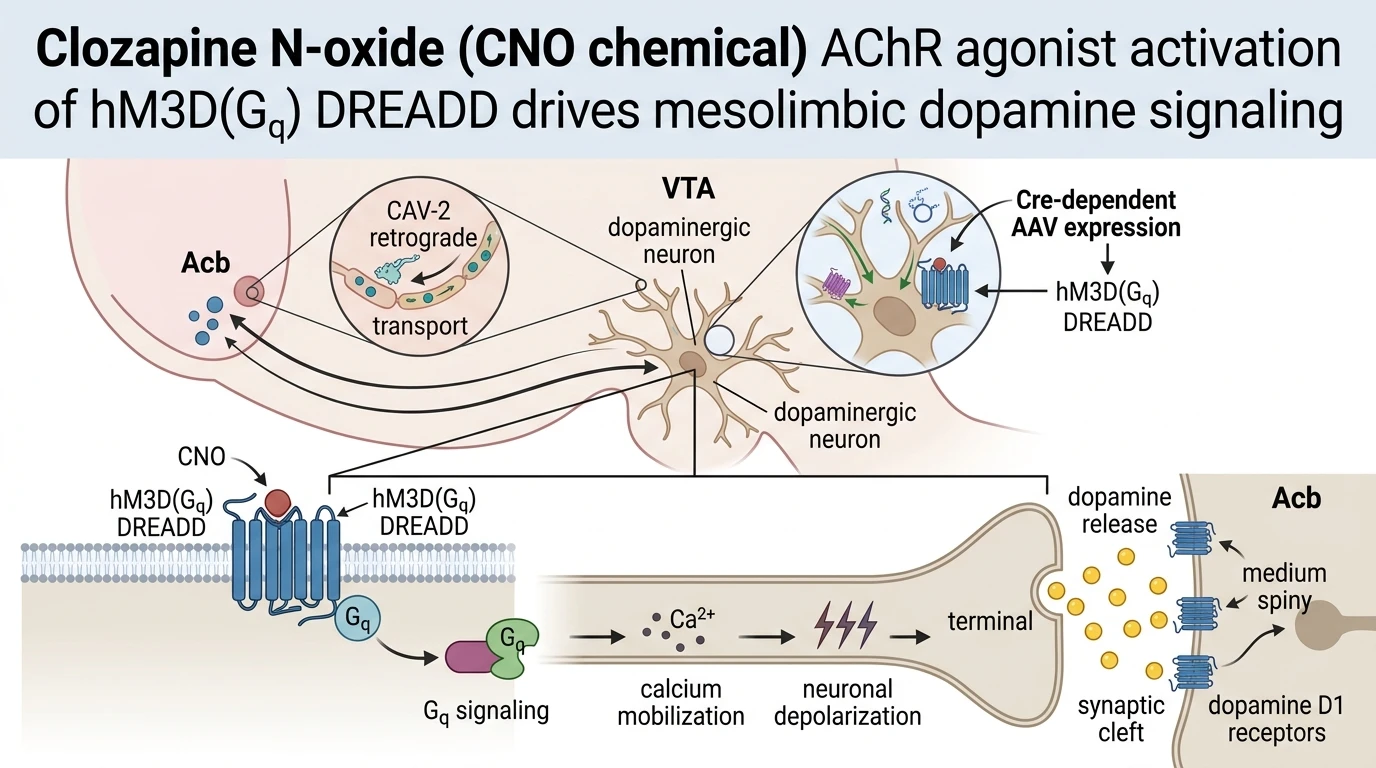
Targeted manipulation of discrete neural circuits requires precise pharmacogenetic tools capable of controlling cell-type-specific neuronal excitability. In this context, the synthetic ligand Clozapine N-oxide (CNO chemical) serves as an actuator for designer receptors exclusively activated by designer drugs (DREADDs). The excitatory hM3D(Gq) receptor, an engineered human M3 muscarinic acetylcholine receptor mutant, displays negligible affinity for endogenous acetylcholine while maintaining high sensitivity to CNO. To achieve pathway-specific gene delivery within the mesolimbic system, a dual-vector viral approach was implemented in adult rat models. Canine adenovirus type 2 (CAV-2), which exhibits preferential retrograde transport along axonal projections, was infused into the nucleus accumbens (Acb) to express Cre-recombinase in neurons projecting from the ventral tegmental area (VTA). Concurrently, a Cre-dependent adeno-associated virus carrying the excitatory DREADD construct, AAV-hSyn-DIO-hM3D(Gq)-mCherry, was microinjected directly into the VTA. This strategy confined functional hM3D(Gq) expression strictly to VTA-to-Acb projection neurons.
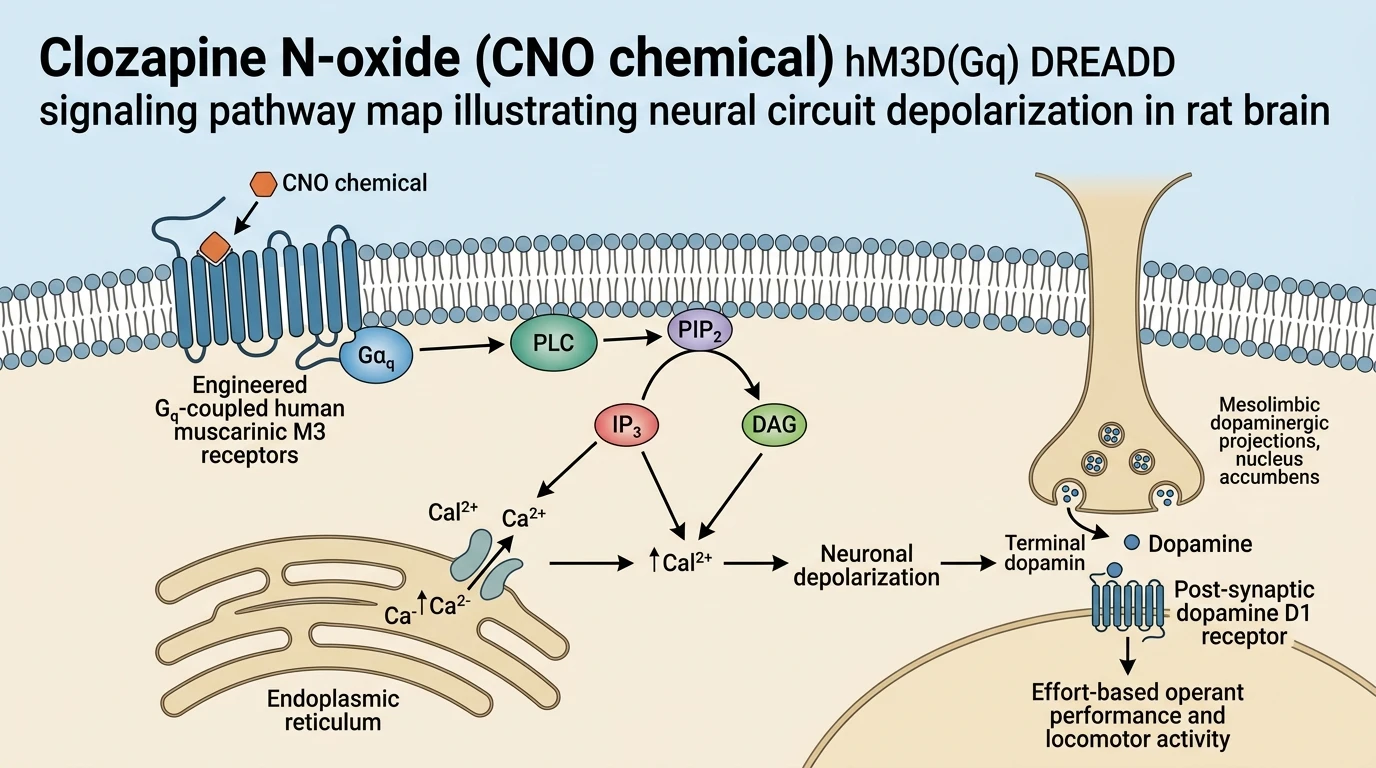
Immunohistochemical validation confirmed that the vast majority of mCherry-labeled projection neurons co-expressed tyrosine hydroxylase. This finding confirmed successful targeting of the dopaminergic mesolimbic pathway. At the cellular level, engagement of hM3D(Gq) by systemic Clozapine N-oxide (CNO chemical) AChR agonist administration activates the classical Gαq-mediated signaling cascade. Phospholipase C (PLC) cleavage of PIP2 generates IP3 and DAG. Intracellular stores release calcium ions into the cytosol. Membrane potential depolarizes rapidly. Neuronal firing rates elevated substantially in a dose-dependent manner under tested physiological conditions.
Systemic delivery of CNO triggered pronounced, transient increases in ambulatory locomotor output. Behavioral evaluation utilizing a progressive ratio operant reinforcement paradigm revealed significant increases in break-point performance. Experimental rats exhibited heightened willingness to expend physical effort to obtain food reinforcers. To verify whether CNO-induced behavioral modulation depended on downstream dopamine liberation, pharmacological intervention was applied at the terminal region. Local microinfusion of the selective dopamine D1 receptor antagonist SCH23390 directly into the nucleus accumbens blocked the CNO-induced increase in progressive ratio operant performance. The selective D1 receptor antagonist abrogated behavioral activation. These empirical observations confirm that CNO acts via pathway-specific hM3D(Gq) activation, culminating in localized terminal dopamine release and post-synaptic D1 receptor stimulation.
Pharmacogenetic Activation of Mesolimbic Circuits and Behavioral Modulation
Copy code to add this image to your page
Pharmacogenetic activation of engineered hM3D(Gq) DREADD receptors by Clozapine N-oxide (CNO) selectively depolarizes VTA-to-Acb projecting dopaminergic neurons. Gq protein coupling activates phospholipase C, triggering intracellular calcium release and increased neuronal firing. Enhanced terminal dopamine release in the nucleus accumbens stimulates post-synaptic dopamine D1 receptors, driving behavioral activation and elevated effort-based operant performance under progressive ratio reinforcement schedules.
Retrograde Dual-Vector Integration Selectively Targets VTA Projections
Selective genetic access to projection-defined neuronal populations was achieved through dual-vector viral intersection. Infusion of CAV-2-Cre into the nucleus accumbens enabled retrograde transport to upstream somas in the ventral tegmental area. Subsequent parenchymal delivery of AAV-hSyn-DIO-hM3D(Gq)-mCherry into the VTA produced circuit-restricted transgene expression. Fluorophore expression was restricted to VTA-to-Acb projecting neurons. Phenotypic characterization revealed that a major fraction of these targeted cells expressed tyrosine hydroxylase, confirming a predominantly dopaminergic identity. Non-target adjacent cells lacked construct expression entirely. The anatomical boundaries remained sharp.
Systemic CNO Activation Enhances Operant Responding in Rats
Administration of Clozapine N-oxide (CNO chemical) AChR agonist produced rapid, dose-dependent increases in neural excitability within the mesolimbic axis. Operant performance was measured using a progressive ratio reinforcement schedule. Low-dose CNO significantly increased the break-point threshold in experimental animals. Rats performed significantly more lever presses per reward session. Locomotor output elevated concurrently following systemic drug challenge. The hyperlocomotor effect waned within hours. Control subjects lacking DREADD expression exhibited no motor or operant changes following CNO exposure.
Intra-Accumbens D1 Receptor Blockade Suppresses CNO-Mediated Responses
To establish whether CNO-induced behavioral performance required local accumbens dopamine signaling, intra-Acb pharmacotherapy was deployed. Infusion of the dopamine D1 receptor antagonist SCH23390 prior to systemic CNO administration completely prevented the enhancement of operant performance. Operant responding returned to baseline levels. The local antagonist challenge verified that downstream dopamine D1 receptor stimulation is necessary for behavioral activation following hM3D(Gq) engagement. Target engagement occurred through selective mesolimbic circuit activation.