Capmatinib (INC280) Sensing via Inner Filter Effect-Driven Fluorescence Quenching of Nitrogen-Doped Carbon Dots
Copy code to add this image to your page
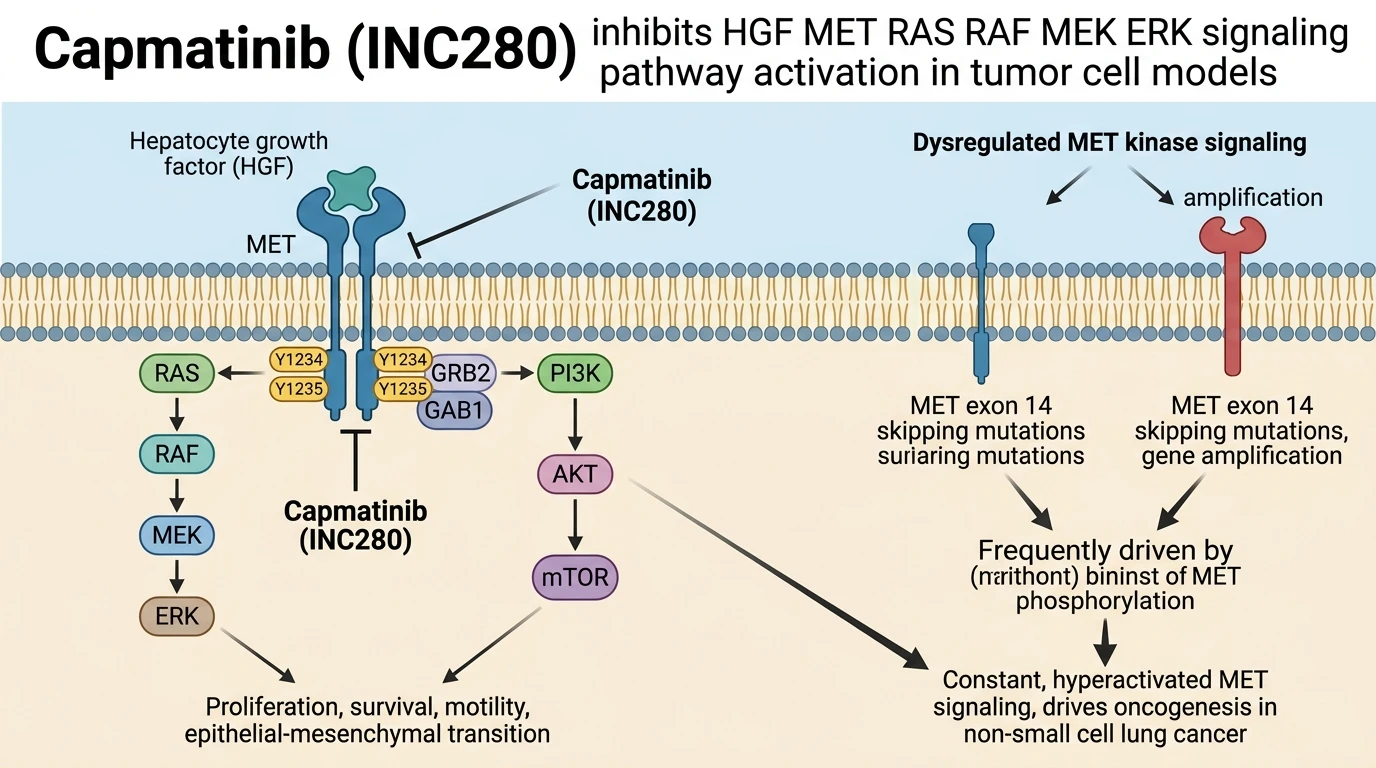
Targeted small-molecule inhibitors of receptor tyrosine kinases have altered clinical oncology, necessitating robust bioanalytical tools for pharmacokinetic tracking and therapeutic drug monitoring. Capmatinib (INC280) is an oral, ATP-competitive small molecule that selectively inhibits the MET receptor tyrosine kinase with nanomolar potency. In clinical settings, capmatinib exhibits substantial antitumor activity in patients harboring non-small cell lung cancer with MET exon 14 skipping mutations or MET amplification. Maintaining therapeutic efficacy while minimizing off-target adverse events requires precise analytical methods to quantify drug concentrations in biological fluids. Traditional detection modalities, such as high-performance liquid chromatography coupled with mass spectrometry, offer high sensitivity but suffer from tedious sample preparation protocols, costly instrumentation, and extended processing times. Optical sensing methods utilizing luminescent nanomaterials provide a rapid, cost-effective, and highly sensitive alternative for real-time drug monitoring.
Fluorescent carbon quantum dots have emerged as versatile probes for chemical and biological sensing due to their tunable optical features, favorable biocompatibility, and chemical stability. Among these, nitrogen-doped carbon dots (NCDs) possess enhanced quantum yield and superior luminescence properties resulting from heteroatom-induced modifications of the carbon core lattice. In this investigation, a low-energy, room-temperature synthetic route was established to construct high-performance NCDs utilizing 2,5-dihydroxy-1,4-benzoquinone and triethylenetetramine as precursor materials. The synthetic procedure circumvents harsh hydrothermal conditions while yielding nanomaterials with bright green fluorescence centered at an emission wavelength of 515 nm. The photophysical characterization of the synthesized NCDs revealed a remarkable absolute fluorescence quantum yield of 38.72%, providing a strong baseline luminescence signal for quenching-based bioassays.
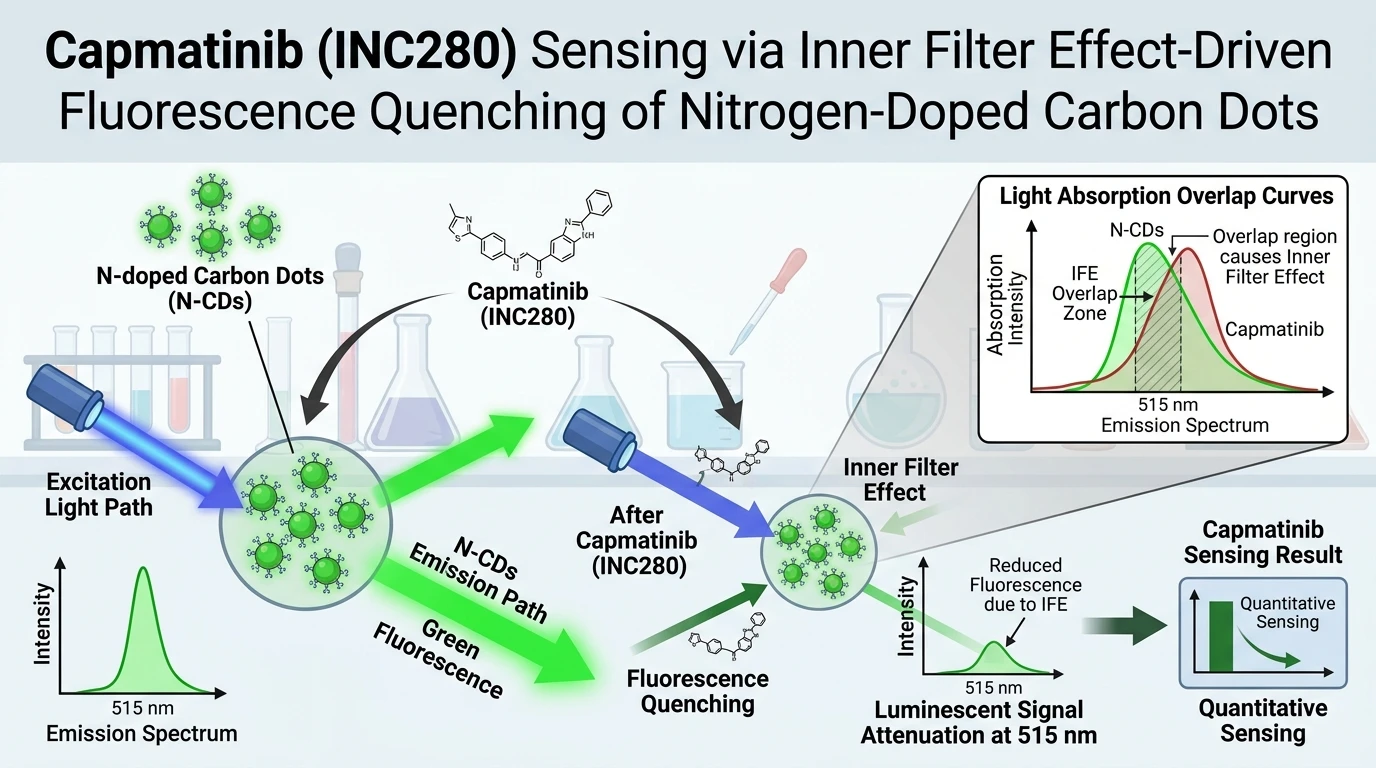
The optical sensing mechanism for capmatinib (INC280) operates through Inner Filter Effect (IFE)-driven fluorescence quenching. IFE occurs when the absorption spectrum of an quencher analyte overlaps significantly with the excitation or emission spectrum of the fluorescent probe, resulting in radiative energy attenuation without forming permanent ground-state non-fluorescent complexes. Spectral overlap analysis confirmed that the UV-vis absorption band of capmatinib aligns precisely with the excitation wavelengths of the green-emitting NCDs. Upon incrementally introducing capmatinib into the NCD suspension, a concentration-dependent decay in luminescence intensity at 515 nm was observed under tested in vitro assay conditions. Time-resolved fluorescence lifetime measurements demonstrated that the average radiative decay lifespan of the NCD fluorophore remained constant across varying quencher concentrations, verifying the dynamic IFE-driven process rather than a static complexation event.
The analytical performance of the NCD optical probe demonstrated high sensitivity and broad operational utility. Under optimized buffer conditions (pH 7.4), the fluorescence attenuation ratio displayed a strong linear correlation across a capmatinib concentration range of 0 to 480 µM. The calculated limit of detection (LOD) reached 3.6 nM, indicating exceptional analytical sensitivity capable of capturing sub-therapeutic drug levels. Selectivity assays evaluated potential interferents commonly present in human biofluids, including serum albumin, amino acids, glucose, and prevalent inorganic cations (Na+, K+, Ca2+, Mg2+). The probe maintained its fluorescence quenching response exclusively toward capmatinib, displaying negligible signal interference from tested physiological biomolecules. Practical utility was confirmed by performing analytical recovery experiments in spiked human serum and urine samples. Method validation yielded recovery rates spanning 97.4% to 105.3% with relative standard deviations below 3.5%, demonstrating robust translational potential for clinical drug monitoring.
Photophysical Characterization and Bioanalytical Application of NCD Probes
Copy code to add this image to your page
Capmatinib (INC280) quantification relies on Inner Filter Effect (IFE)-driven fluorescence quenching of nitrogen-doped carbon dots (NCDs). Synthesized from 2,5-dihydroxy-1,4-benzoquinone and triethylenetetramine, NCDs exhibit bright emission at 515 nm with a quantum yield of 38.72%. Spectral overlap between capmatinib absorption and NCD excitation profiles enables selective non-radiative energy attenuation. The probe operates across a linear range of 0–480 µM with a detection limit of 3.6 nM. Method validation in human serum and urine matrices achieved 97.4%–105.3% recovery rates, establishing practical utility for pharmacokinetic evaluation.
Synthesis and Optical Properties of Green Emitting Carbon Dots
Room-temperature condensation of 2,5-dihydroxy-1,4-benzoquinone and triethylenetetramine yielded nitrogen-doped carbon dots with minimal thermal energy input. Photoluminescence emission spectra displayed a prominent, symmetric peak centered precisely at 515 nm under an excitation wavelength of 410 nm. Luminescence intensity peaked at 515 nm. Absolute quantum yield measurements established an emission efficiency of 38.72% in aqueous media. Structural characterization confirmed successful incorporation of nitrogen heteroatoms into the sp2-hybridized carbon core, imparting stable colloidal dispersibility; steady-state fluorescence intensity showed negligible photobleaching across extended UV irradiation periods.
Inner Filter Effect Drives Selective MET Inhibitor Fluorescence Quenching
Introduction of the MET inhibitor INC280 induced steady concentration-dependent quenching of NCD photoluminescence. The linear detection boundary spanned 0 to 480 µM. Spectroscopic evaluation revealed a pronounced overlap between the UV absorption profile of capmatinib and the excitation spectrum of NCDs, confirming an Inner Filter Effect mechanism. Fluorescence lifetime analysis yielded a constant decay value of 4.2 ns across all titration points—a signature characteristic of non-radiative IFE attenuation. The calculated limit of detection reached 3.6 nM under optimized assay parameters. Selectivity margins remained intact. Common physiological ions, amino acids, and plasma proteins failed to alter the optical emission profile.
Pharmacokinetic Monitoring in Human Serum and Urine Matrices
To establish bioanalytical applicability, spiked biological fluid assays were conducted using human serum and urine matrices. Matrix effects were minimized through preliminary sample dilution in phosphate-buffered saline (pH 7.4). Quantitative recovery rates for INC280 in spiked human serum ranged from 97.4% to 103.8%, while urine samples yielded recoveries between 98.6% and 105.3%. Relative standard deviations remained consistently below 3.5% across all tested concentration tiers. These empirical results demonstrate that the NCD fluorescence quenching probe provides a reliable, high-throughput analytical platform for monitoring therapeutic drug concentrations in complex biofluids.