Z-IETD-FMK, ZIETDFMK from Selleck, Blocks Caspase-8-Mediated Neuronal Apoptosis in Ischemia
Copy code to add this image to your page
Spinal cord ischemia-reperfusion (IR) injury initiates a rapid biochemical cascade leading to severe neurodegeneration and loss of motor function. Oxygen-glucose deprivation followed by reoxygenation (OGD/R) disrupts cellular redox equilibrium and calcium homeostasis within spinal motor neurons. Intracellular calcium accumulation triggers the pathological activation of calpains, a family of calcium-dependent neutral cysteine proteases. In particular, the calpain-2 (CAPN-2) isoform undergoes marked overactivation during acute ischemic stress. Under physiological conditions, microRNA-137-3p (miR-137-3p) negatively regulates CAPN-2 mRNA translation, maintaining enzymatic activity within narrow baseline boundaries. Ischemic conditions suppress endogenous miR-137-3p levels, releasing CAPN-2 from post-transcriptional repression.
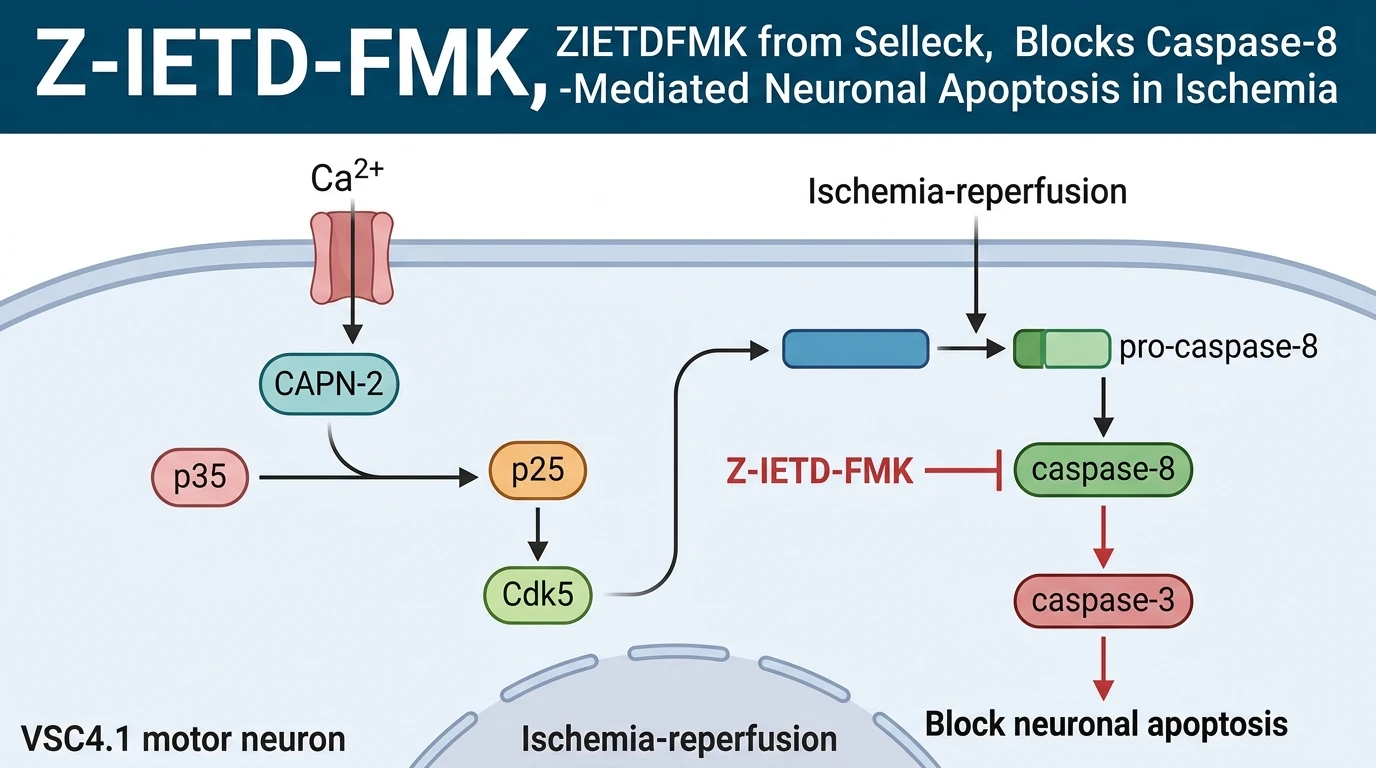
Uninhibited CAPN-2 activity catalyzes the truncated cleavage of p35, a neuron-specific activator of cyclin-dependent kinase 5 (Cdk5). Cleavage of p35 yields p25, a stable peptide fragment that displays prolonged binding affinity for Cdk5. The resulting p25/Cdk5 complex mislocalizes to the cytoplasm and hyperactivates Cdk5 kinase function. Hyperactive Cdk5 disrupts cytoskeletal stability and initiates the downstream apoptotic machinery by promoting pro-caspase-8 cleavage. Pro-caspase-8 serves as an essential initiator protease residing at the apex of the apoptotic cascade. Cdk5-driven signaling accelerates the dimerization and self-cleavage of pro-caspase-8 into fully active caspase-8 enzymatic subunits.
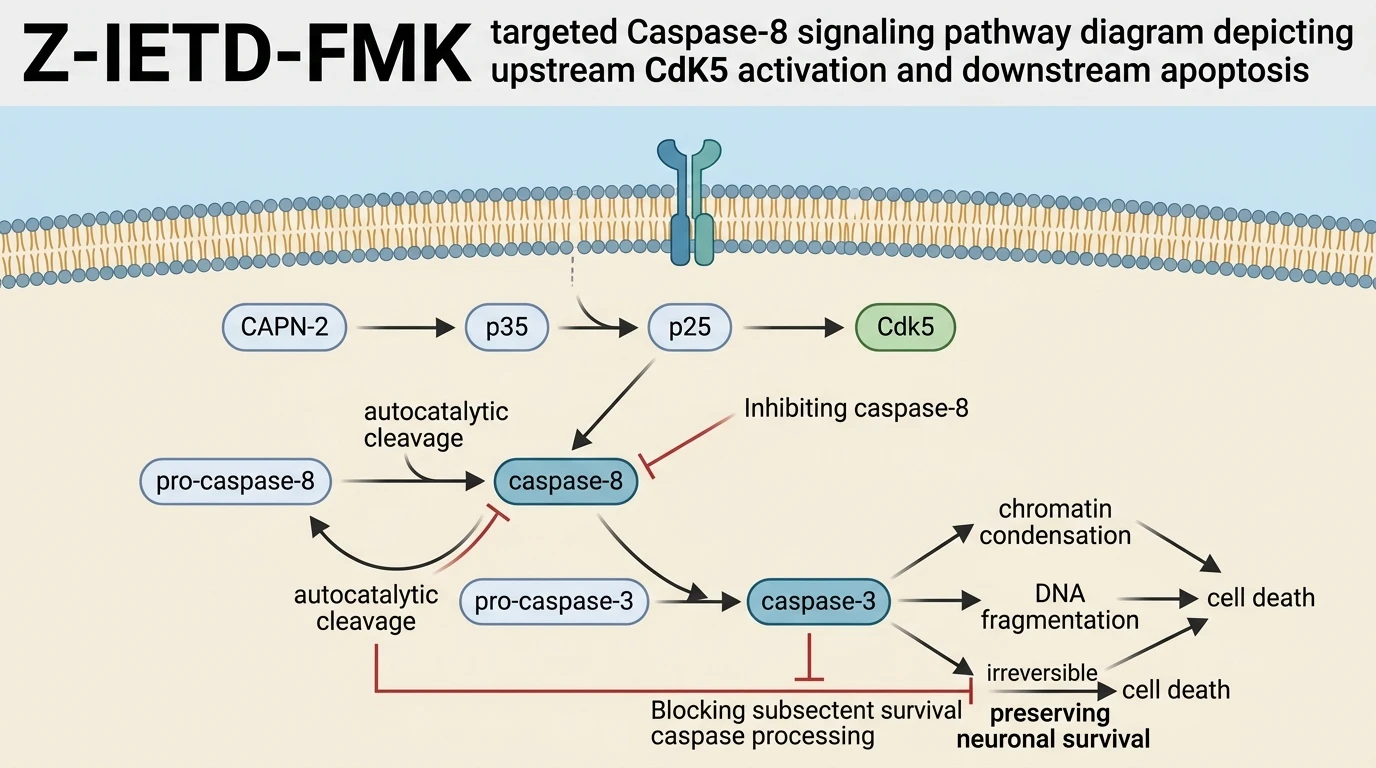
Once generated, active caspase-8 directly cleaves downstream pro-caspase-3, generating active executioner caspase-3. Active caspase-3 targets structural cytoskeletal elements and activates caspase-activated DNase (CAD), precipitating widespread DNA fragmentation, chromatin condensation, and cell death. Blocking this pathway at the initiator level represents a direct therapeutic strategy. Pharmacological targeting with Z-IETD-FMK offers a high degree of target specificity. Z-IETD-FMK incorporates a synthetic tetrapeptide sequence (Ile-Glu-Thr-Asp) tailored to match the substrate preference of the caspase-8 catalytic pocket, linked to a fluoromethyl ketone (FMK) reactive handle. Upon entering the cell, Z-IETD-FMK binds irreversibly to the active site cysteine of caspase-8, preventing substrate binding and proteolytic turnover.
Experimental investigation of this signaling network in VSC4.1 motor neurons subjected to in vitro OGD/R demonstrated the crucial function of caspase-8. Exposure of VSC4.1 cells to OGD/R resulted in upregulation of CAPN-2, elevated p25/p35 expression ratios, and heightened Cdk5 phosphorylation. This upstream activation yielded high levels of cleaved caspase-8 and executioner caspase-3. Application of Z-IETD-FMK effectively suppressed caspase-8 enzymatic activity in treated cells. Western blot analyses revealed a significant, dose-dependent decrease in mature caspase-8 protein subunits alongside a parallel attenuation of active caspase-3 levels. Employing small-molecule enzymatic inhibitors like Z-IETD-FMK demonstrates the strict requirement for active caspase-8 in transmitting upstream p25/Cdk5 death signals.
Flow cytometric analysis using Annexin V/propidium iodide staining confirmed that Z-IETD-FMK administration reduced neuronal apoptotic rates under OGD/R challenge. Motor neuron viability was preserved at levels comparable to those observed following transfection with miR-137-3p mimics or direct Cdk5 inhibition using roscovitine. These findings establish that caspase-8 activation is a key required event downstream of the miR-137-3p/CAPN-2/p25/Cdk5 signaling axis. The specific inhibition provided by Z-IETD-FMK clarifies the biochemical sequence driving motor neuron loss during ischemic injury.
The cell-permeable nature of Z-IETD-FMK is enhanced by N-terminal benzyloxycarbonyl (Z) modification, facilitating rapid passage across neuronal plasma membranes without requiring carrier vehicles. In comparative kinetic assays, Z-IETD-FMK exhibits significantly higher inhibitory selectivity for caspase-8 relative to caspase-1, caspase-3, or caspase-9 at micromolar working concentrations. Within the context of VSC4.1 motor neuron cultures, this selective profile minimizes off-target toxicity while providing clean inhibition of initiator caspase signaling. Consequently, Z-IETD-FMK serves as a valuable chemical biology tool for validating caspase-8-dependent neurodegenerative mechanism models under acute ischemic stress.
Pharmacological Inhibition of Caspase-8 in Neuronal Ischemia
Copy code to add this image to your page
Z-IETD-FMK is a cell-permeable, irreversible peptide inhibitor that specifically targets caspase-8. By forming a covalent bond with the catalytic cysteine residue of pro-caspase-8 and active caspase-8, Z-IETD-FMK blocks pro-apoptotic cleavage downstream of the miR-137-3p/CAPN-2/p25/Cdk5 signaling axis. This inhibition prevents pro-caspase-3 cleavage into active executioner caspase-3, suppressing chromatin condensation, DNA fragmentation, and neuronal cell death during oxygen-glucose deprivation and reperfusion injury.
CAPN-2 Proteolysis Drives p25/Cdk5 and Caspase-8 Activation
In VSC4.1 motor neuron cultures subjected to oxygen-glucose deprivation and reperfusion, ischemic stress significantly suppressed endogenous miR-137-3p levels. Reduced microRNA control permitted the marked upregulation of calpain-2 activity. Hyperactive calpain-2 catalyzed the cleavage of native p35 into p25. Elevated p25 concentrations sustained aberrant activation of Cdk5 kinase. Active Cdk5 complexes directly initiated pro-caspase-8 cleavage, activating the caspase cascade. Cell viability declined significantly under these conditions. Quantitative Western blotting verified elevated protein levels of cleaved caspase-8 within hours following reoxygenation.
Z-IETD-FMK Inhibits Executioner Caspase Processing in Neurons
Treatment of OGD/R-injured motor neurons with Z-IETD-FMK rapidly blocked caspase-8 catalytic cleavage. Applying ZIETDFMK from Selleck reduced intracellular levels of active caspase-8 and downstream cleaved caspase-3. Cellular apoptosis rates decreased markedly across treated culture conditions. Short-term application maintained structural integrity of motor neuron axons and soma. The observed neuroprotection matched the efficiency of direct Cdk5 inhibition with roscovitine and miR-137-3p mimic transfection. Within this cellular model, ZIETDFMK from Selleck effectively disconnected upstream calpain-2/Cdk5 stress signals from downstream executioner caspase activation.
Attenuation of Motor Neuron Death Under Ischemia Reperfusion
Targeting initiator caspase activity provides clear protection against OGD/R-induced cytotoxic stress. In vitro observations indicate that blocking caspase-8 stops the irreversible cleavage of structural substrates. Using ZIETDFMK from Selleck confirms that caspase-8 functions as a central execution node in ischemia-driven neuronal death. Cellular viability assays showed enhanced cell survival relative to untreated control groups. These findings highlight the pharmacological utility of selective caspase-8 blockade in model systems of spinal cord ischemia.