Actinomycin D (Dactinomycin) reveals m6A-mediated TMBIM6 mRNA decay kinetics in LSCC
Copy code to add this image to your page
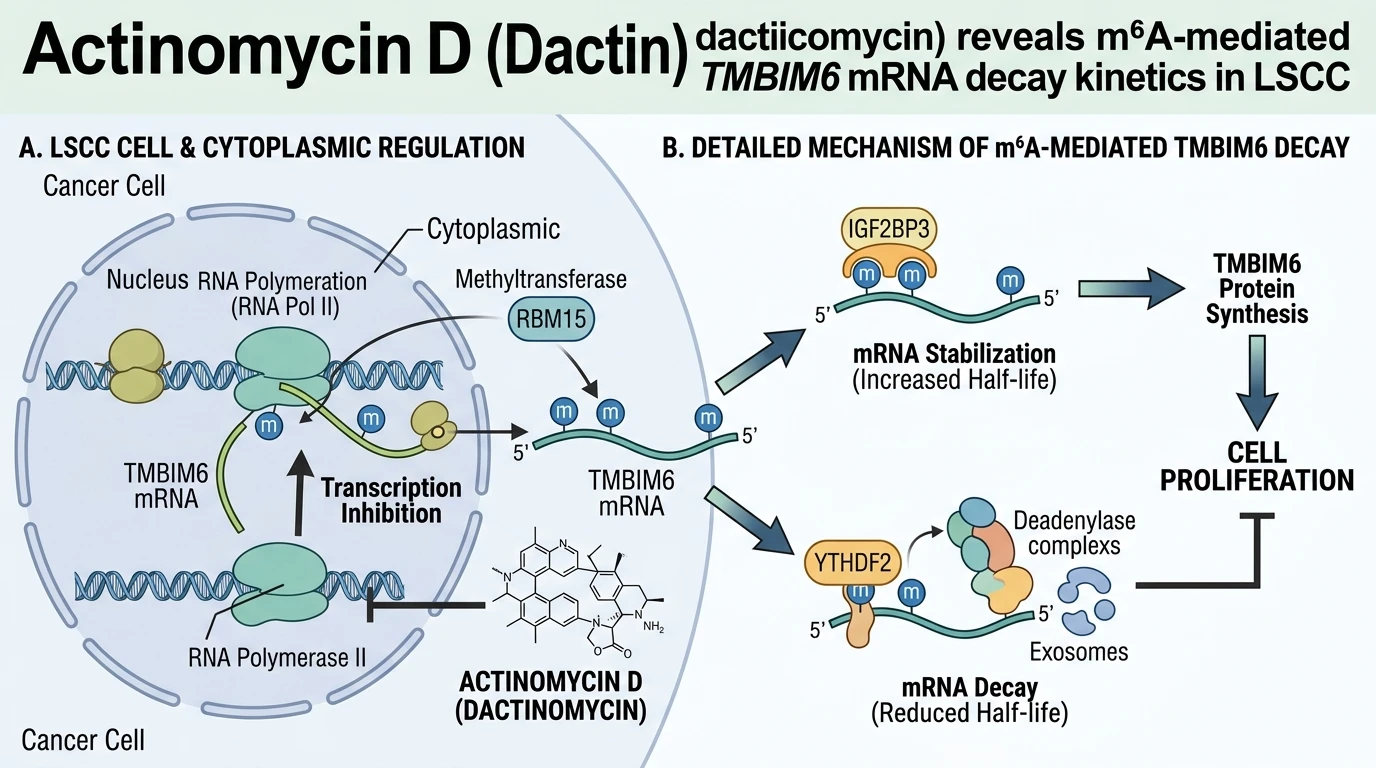
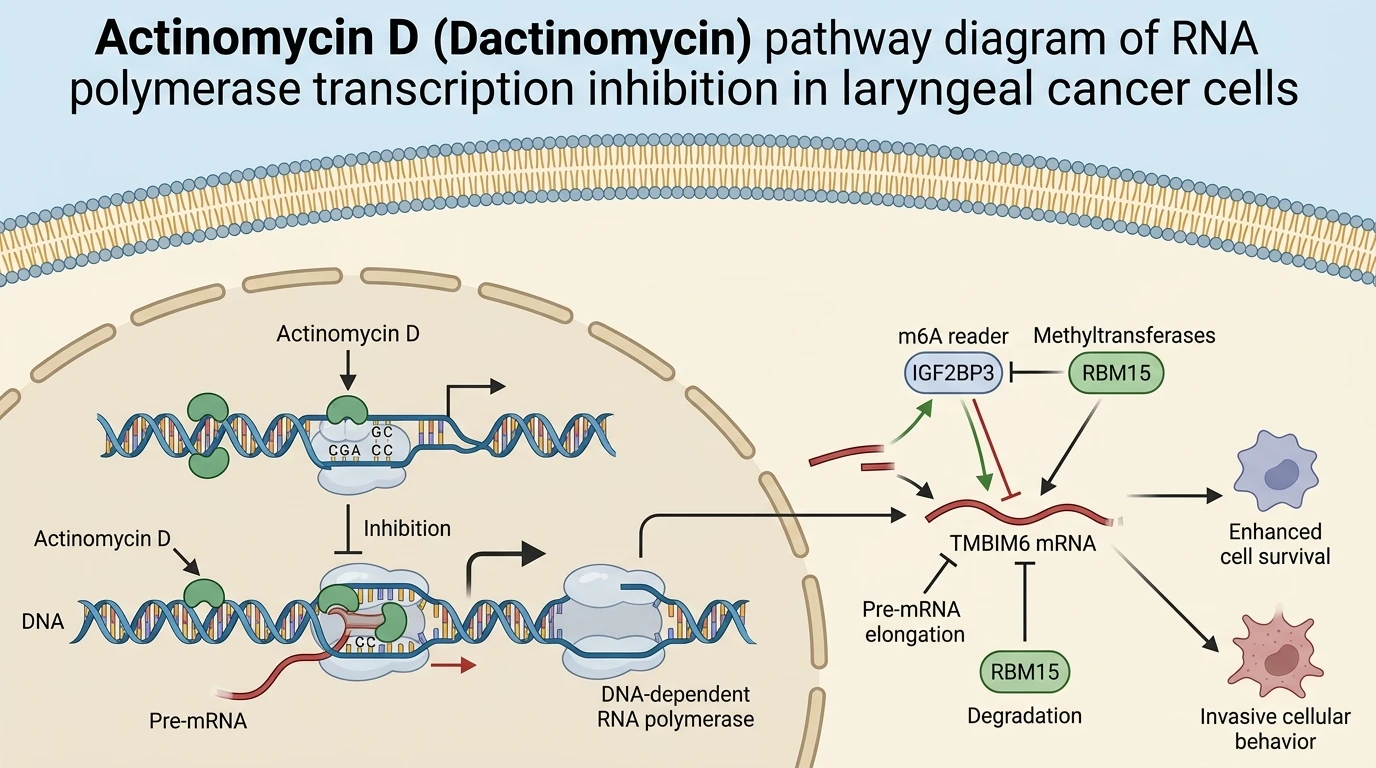
Actinomycin D (Dactinomycin) functions as a chromopeptide antibiotic that binds double-stranded DNA via intercalation. The phenoxazone ring system inserts preferentially between adjacent cytosine-guanine (dG-dC) base pairs, while the cyclic pentapeptide moieties settle into the minor groove of the double helix. This stable drug-DNA adduct generates sterical hindrance along the template strand. Consequently, DNA-dependent RNA polymerase elongation complexes encounter physical blockade during transcription, leading to premature transcript termination and rapid cessation of de novo RNA synthesis within minutes of exposure.
In molecular oncology and transcriptomics, transcriptional arrest mediated by Actinomycin D (Dactinomycin) serves as a primary standard for evaluating post-transcriptional mRNA kinetics. Halting nuclear transcription enables researchers to isolate the decay dynamics of existing cytosolic transcript pools over defined timecourses. Under baseline cellular homeostasis, mRNA turnover depends on deadenylation, decapping, and exonucleolytic cleavage cascades. However, internal chemical modifications—notably N6-methyladenosine (m6A)—fundamentally alter transcript vulnerability to these degradation machineries.
In laryngeal squamous cell carcinoma (LSCC) models, transmembrane BAX inhibitor motif containing 6 (TMBIM6) mRNA exhibits marked expression elevations that correlate with aggressive cellular traits. Structural analysis indicates that TMBIM6 transcripts undergo epitranscriptomic modification catalyzed by the m6A methyltransferase-like complex subunit RBM15. RBM15 targets specific adenosine residues within the 3' untranslated region (3' UTR) and coding sequences of TMBIM6 pre-mRNA. This m6A deposition creates specific binding motifs recognized by cytosolic m6A reader proteins, particularly insulin-like growth factor 2 mRNA-binding protein 3 (IGF2BP3).
Quantitative evaluation of TMBIM6 transcript longevity requires robust suppression of baseline transcription. When Actinomycin D (Dactinomycin) is administered to cultured LSCC cells at concentrations sufficient to shut down RNA polymerase II activity, the decay rate of TMBIM6 mRNA can be tracked via sequential quantitative reverse transcription-polymerase chain reaction (RT-qPCR) measurements. In control populations, TMBIM6 transcripts demonstrate an extended half-life exceeding six hours. Conversely, targeted genetic knockdown of RBM15 significantly accelerates TMBIM6 degradation, reducing transcript half-life to under two hours following transcriptional blockade.
Mechanistic assays show that IGF2BP3 acts as a functional effector downstream of RBM15-mediated m6A methylation. IGF2BP3 contains KH domains that selectively engage m6A-marked TMBIM6 transcripts, forming ribonucleoprotein complexes that shield the mRNA from endonucleolytic cleavage complexes. Experimental depletion of IGF2BP3 mirrors the rapid TMBIM6 clearance observed during RBM15 silencing upon Actinomycin D (Dactinomycin) treatment. Conversely, ectopic overexpression of either RBM15 or IGF2BP3 restores TMBIM6 transcript persistence even during prolonged transcription inhibition.
Experimental protocols utilizing Actinomycin D (Dactinomycin) typically employ working concentrations between 2 to 5 ug/mL to achieve complete transcription inhibition without inducing immediate cytotoxic off-target responses within early assay windows. At these titrated doses, nuclear pre-mRNA production halts rapidly, permitting accurate mathematical modeling of first-order mRNA decay constants and half-life values. Comparing these kinetic parameters across wild-type and mutant TMBIM6 constructs demonstrates that point mutations at predicted m6A consensus sites abrogate IGF2BP3 binding, accelerating transcript clearance in a manner identical to RBM15 deletion.
The stabilization of TMBIM6 mRNA directly drives pathological cell phenotypes in LSCC. TMBIM6 encodes an endoplasmic reticulum-localized protein that regulates intracellular calcium homeostasis and suppresses intrinsic apoptotic pathways. Sustained TMBIM6 expression blunts caspase-3 activation, preserves mitochondrial membrane potential, and promotes cell proliferation, migration, and invasive capacity through extracellular matrix barriers. By employing Actinomycin D (Dactinomycin) to isolate transcript degradation rates from transcriptional synthesis, empirical measurements confirm that m6A modification directly controls the cellular persistence of TMBIM6 transcripts rather than altering nuclear transcription initiation rates.
Pharmacological Quantification of Post-Transcriptional mRNA Stability
Copy code to add this image to your page
Actinomycin D (Dactinomycin) binds DNA duplexes at GC-rich sequences, physically blocking RNA polymerase translocation and ceasing de novo mRNA synthesis. Stopping transcription permits measuring real-time degradation kinetics of target mRNAs. In laryngeal squamous cell carcinoma models, assessing TMBIM6 transcript longevity following transcriptional arrest demonstrates that m6A modification by RBM15 and recognition by IGF2BP3 shield TMBIM6 from endonucleolytic degradation, sustaining oncogenic downstream phenotypes.
RBM15 Depletion Accelerates TMBIM6 Transcriptional Decay
Application of Actinomycin D (Dactinomycin) at 5 ug/mL to laryngeal squamous cell carcinoma cell lines established a baseline TMBIM6 mRNA half-life of approximately 6.4 hours. Small interfering RNA (siRNA) knockdown of the methyltransferase subunit RBM15 significantly altered these decay kinetics. Following transcriptional arrest, TMBIM6 mRNA levels dropped markedly in RBM15-depleted cells, yielding a reduced half-life of 2.1 hours. Target degradation accelerated rapidly. Quantitative RT-qPCR tracking across a 12-hour chase period confirmed that m6A modification catalyzed by RBM15 protects TMBIM6 transcripts from cytosolic decay pathways. Without m6A deposition, transcripts exhibit heightened sensitivity to intrinsic ribonucleases.
IGF2BP3 Engagement Extends TMBIM6 Transcript Half-Life
To identify the m6A reader responsible for TMBIM6 stabilization, reader protein depletion experiments were monitored under Actinomycin D (Dactinomycin) exposure. Knockdown of IGF2BP3 reproduced the rapid TMBIM6 mRNA decay observed with RBM15 deficiency—reducing transcript half-life from 6.2 hours to 2.3 hours. Transcript persistence was severely compromised. Conversely, re-expression of wild-type IGF2BP3, but not m6A-binding-deficient mutants, rescued TMBIM6 transcript persistence. Biologically, sustained TMBIM6 mRNA levels attenuated apoptosis and enhanced cell migration in vitro. These observations demonstrate that IGF2BP3 binds m6A sites on TMBIM6 mRNA, preventing endonucleolytic turnover and driving aggressive laryngeal cancer cell phenotypes.