Forskolin (Colforsin) from Selleck activates adenylate cyclase to restore meiotic competence in denuded oocytes
Copy code to add this image to your page
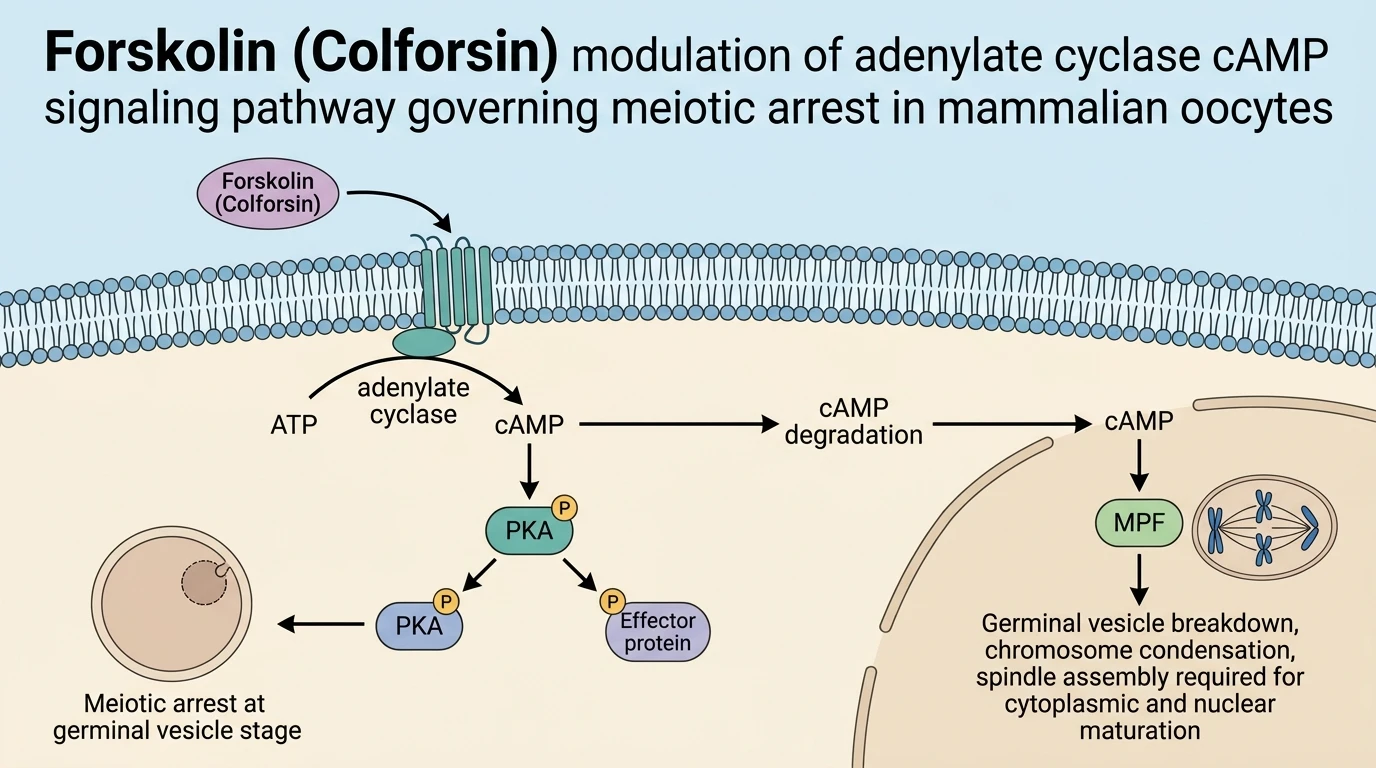
Direct engagement of transmembrane adenylate cyclase governs second messenger dynamics within mammalian germ cells. Intracellular cyclic adenosine monophosphate (cAMP) acts as the primary molecular break maintaining meiotic arrest at the germinal vesicle (GV) stage. Under physiological conditions in vivo, follicular cumulus cells synthesize cAMP and transport it into the oocyte through specialized gap junctional networks. Physical detachment of cumulus cells during isolation disrupts this essential metabolic coupling. In denuded oocytes (DOs), the immediate loss of somatic cAMP input triggers a rapid drop in intracellular nucleotide concentration. Unregulated cAMP depletion forces premature germinal vesicle breakdown (GVBD) before the ooplasm achieves cytoplasmic maturation. Premature nuclear progression decouples chromatin condensation from cytoplasmic organelle reorganization, severely impairing downstream developmental potential.
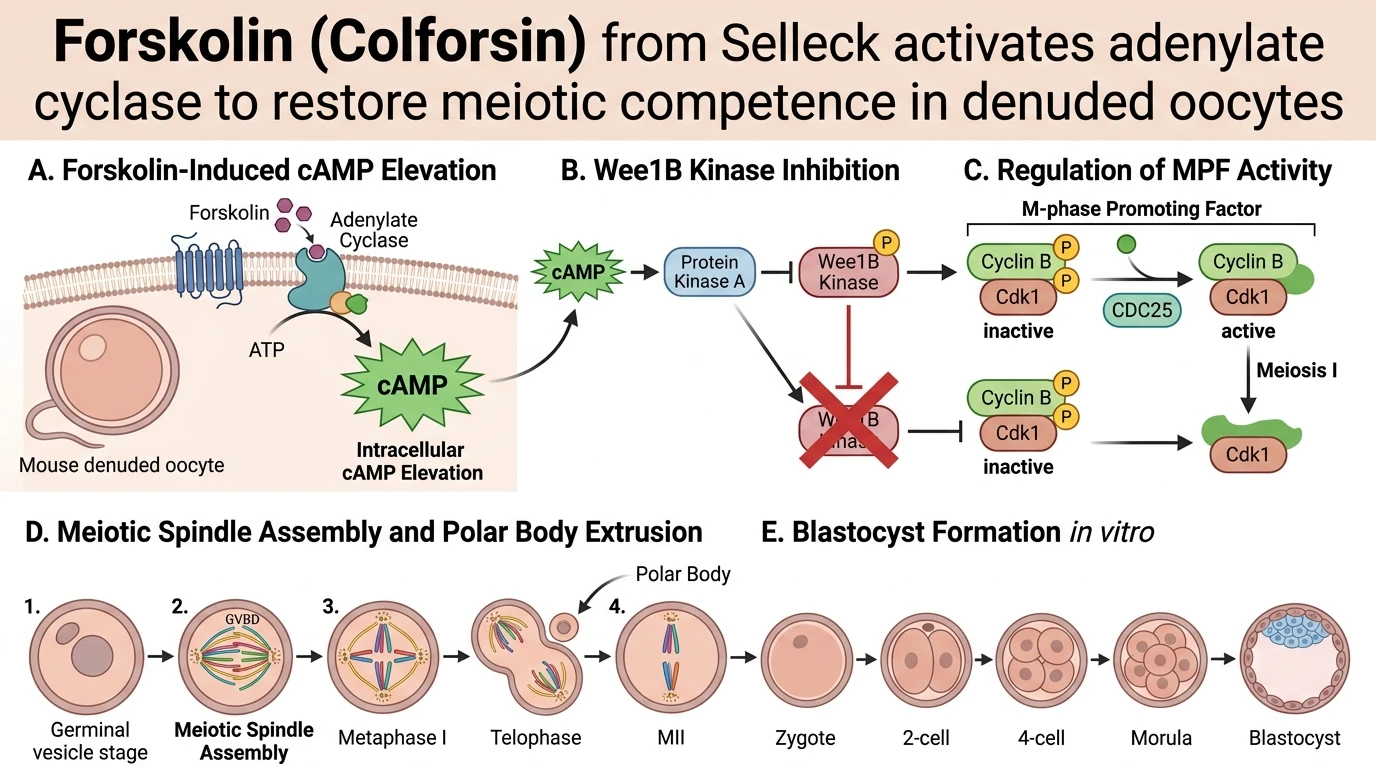
To correct this cellular desynchrony, artificial modulation of intracellular signaling nodes becomes necessary. Forskolin (Colforsin) functions as a direct small-molecule activator of adenylate cyclase isoforms. Unlike physiological ligands that require G-protein coupled receptor engagement, this cell-permeable diterpene binds directly to the catalytic domain of transmembrane adenylate cyclase. Enzymatic acceleration converts adenosine triphosphate (ATP) into cyclic AMP within minutes of administration. High intracellular cAMP levels engage cyclic-AMP-dependent protein kinase A (PKA). Active PKA phosphorylates specific downstream targets, maintaining inhibitory phosphorylation on CDK1 and suppressing maturation-promoting factor (MPF) assembly. Through this action, meiotic resumption remains transiently blocked.
Experimental protocols using Forskolin (Colforsin) from Selleck established a controlled biphasic treatment system to synchronize nuclear and cytoplasmic maturation in vitro. Denuded mouse oocytes exposed to 50 µM Forskolin for 3 hours maintained robust meiotic arrest at the GV stage. This temporary hold prevents premature GVBD in the total absence of surrounding cumulus cells. During this 3-hour window, essential intracellular transformations take place within the cytoplasm. Mitochondria migrate to pericortical regions, endoplasmic reticulum networks undergo structural remodeling, and maternal RNA transcripts stabilize. These organelle movements ensure that cytoplasmic components reach full maturation maturity prior to nuclear division.
Following the initial cAMP elevation phase, controlled release from meiotic arrest requires dynamic manipulation of downstream kinase nodes. Researchers transferred the arrested oocytes into culture media containing 2.5 µM PD166285 for 21 hours. PD166285 acts as a potent inhibitor of Wee1B kinase, an upstream enzyme responsible for maintaining inhibitory phosphorylation on CDK1 at Tyr15. By inhibiting Wee1B kinase, MPF undergoes rapid dephosphorylation and activation, accelerating synchronized nuclear maturation. Standardized comparative data documented across comparative embryology databases highlight how precisely timed enzymatic inhibition mimics physiological somatic signal suppression during folliculogenesis.
The sequential combination of initial adenylate cyclase activation and subsequent Wee1B kinase suppression yielded remarkable maturation metrics in denuded germ cells. Treated mouse DOs achieved a metaphase II (MII) maturation rate of 76.71% in vitro without gonadotropin support or cumulus cell co-culture. Immunofluorescence analysis verified barrel-shaped meiotic spindle assembly with properly aligned chromosomes at the equatorial plate. Following parthenogenetic activation, treated oocytes demonstrated an 18.33% blastocyst rate. In vitro fertilization (IVF) assays confirmed full functional capacity; matured oocytes fertilized normally and, upon transfer into pseudopregnant surrogate mothers, developed into healthy, fertile live offspring. Direct pharmacological target engagement of adenylate cyclase thus successfully bypasses the requirement for somatic support during in vitro maturation protocols.
Pharmacological Regulation of Oocyte Maturation Cascades
Copy code to add this image to your page
Forskolin (Colforsin) directly stimulates adenylate cyclase, rapidly inducing intracellular cAMP accumulation. In denuded mouse oocytes, an initial surge of cAMP transiently maintains meiotic arrest. Subsequent inhibition of Wee1B kinase regulates maturation-promoting factor activity, enabling synchronized resumption of meiosis. This biphasic pharmacological modulation bypasses gonadotropin requirement, promoting normal spindle formation, polar body extrusion, and blastocyst formation after fertilization under controlled in vitro culture conditions.
Adenylate Cyclase Activation Prevents Premature Meiotic Resumption
Direct activation of adenylate cyclase by Forskolin (Colforsin) from Selleck established a predictable meiotic hold in denuded mouse oocytes. Intracellular cAMP levels accumulated within minutes of exposure. This sharp increase sustained downstream PKA activation under tested in vitro conditions. Active PKA phosphorylated effector targets to block premature MPF assembly. Consequently, germinal vesicle breakdown was delayed for 3 hours. Spontaneous nuclear progression ceased completely. This temporary arrest window provided crucial time for cytoplasmic maturation events. Mitochondria relocated toward the perinuclear zone. RNA synthesis shifted toward storage transcripts needed for cleavage. Without initial cAMP elevation, isolated oocytes underwent premature nuclear division with poor developmental prognosis.
Wee1B Kinase Inhibition Accelerates Synchronized Nuclear Progression
Following the cAMP elevation phase, exposure to 2.5 µM PD166285 initiated synchronized meiotic resumption. PD166285 selectively inhibited Wee1B kinase across the 21-hour culture period. Targeted suppression of Wee1B induced rapid dephosphorylation of CDK1 at Tyr15. Active MPF complexes drove coordinated nuclear envelope breakdown. Metaphase transitions proceeded with high structural fidelity. Treated denuded oocytes achieved a metaphase II maturation rate of 76.71%. Immunofluorescence staining confirmed normal bipolar meiotic spindles with aligned chromosomes. Following parthenogenetic activation, blastocyst formation reached 18.33% in vitro. Subsequent fertilization assays yielded fertile live offspring after embryo transfer. These empirical results confirm that sequential enzymatic manipulation restores full developmental potential in denuded germ cells.