MDM2/MDMX Inhibitors
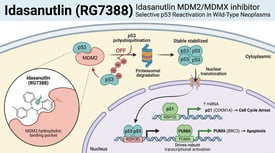
The MDM2 and MDMX (also known as MDM4) proteins are the primary negative regulators of the p53 tumor suppressor, a critical 'guardian of the genome' that induces cell cycle arrest or apoptosis in response to DNA damage. MDM2 functions as an E3 ubiquitin ligase that targets p53 for proteasomal degradation, while both MDM2 and MDMX can directly bind to the p53 transactivation domain to inhibit its transcriptional activity. In many human cancers, particularly those retaining wild-type p53, MDM2 or MDMX are frequently overexpressed, leading to the functional inactivation of p53 and subsequent uncontrolled tumor growth. This makes the MDM2/MDMX-p53 interaction a highly attractive target for therapeutic intervention. The primary goal of inhibitors in this class is to disrupt the physical interaction between MDM2/MDMX and p53, thereby stabilizing p53 and restoring its tumor-suppressive functions.
Research progress has led to the development of several classes of inhibitors, most notably the Nutlins (cis-imidazoline analogs), with Idasanutlin (RG7112) being one of the first to enter clinical trials. Other potent small molecules include AMG-232, Siremadlin (HDM201), and Milademetan. While early inhibitors focused solely on MDM2, it was discovered that MDMX can compensate for MDM2 inhibition, leading to resistance. Consequently, dual MDM2/MDMX inhibitors, including stapled peptides like ALRN-6924, have been developed to provide more comprehensive p53 reactivation. These inhibitors are generally classified into small-molecule inhibitors and peptide-based inhibitors.
Small molecules typically mimic the three key hydrophobic residues of p53 (Phe19, Trp23, and Leu26) that fit into the MDM2 binding pocket. Clinical trials have primarily targeted hematological malignancies like acute myeloid leukemia (AML) and solid tumors such as well-differentiated liposarcoma, where MDM2 amplification is a hallmark. However, significant challenges remain, including dose-limiting hematological toxicities such as thrombocytopenia and neutropenia, which result from p53 activation in normal bone marrow cells. Furthermore, the emergence of p53 mutations during treatment serves as a major resistance mechanism. To mitigate these issues, current research is exploring intermittent dosing schedules and combination strategies with other agents, such as MEK inhibitors or BCL-2 inhibitors like Venetoclax, to enhance the pro-apoptotic effect.
Tool compounds like Nutlin-3a remain indispensable for studying p53 dynamics in vitro. As the field evolves, the focus is shifting toward identifying biomarkers that can better predict patient response and developing more selective dual-targeting agents that can overcome the limitations of first-generation MDM2 monotherapy, potentially expanding the utility of these drugs to a broader range of p53-proficient malignancies.