ABT-737 ABT737 Bcl-2 inhibitor Synergism via Mcl-1 Suppression in T-ALL
Copy code to add this image to your page
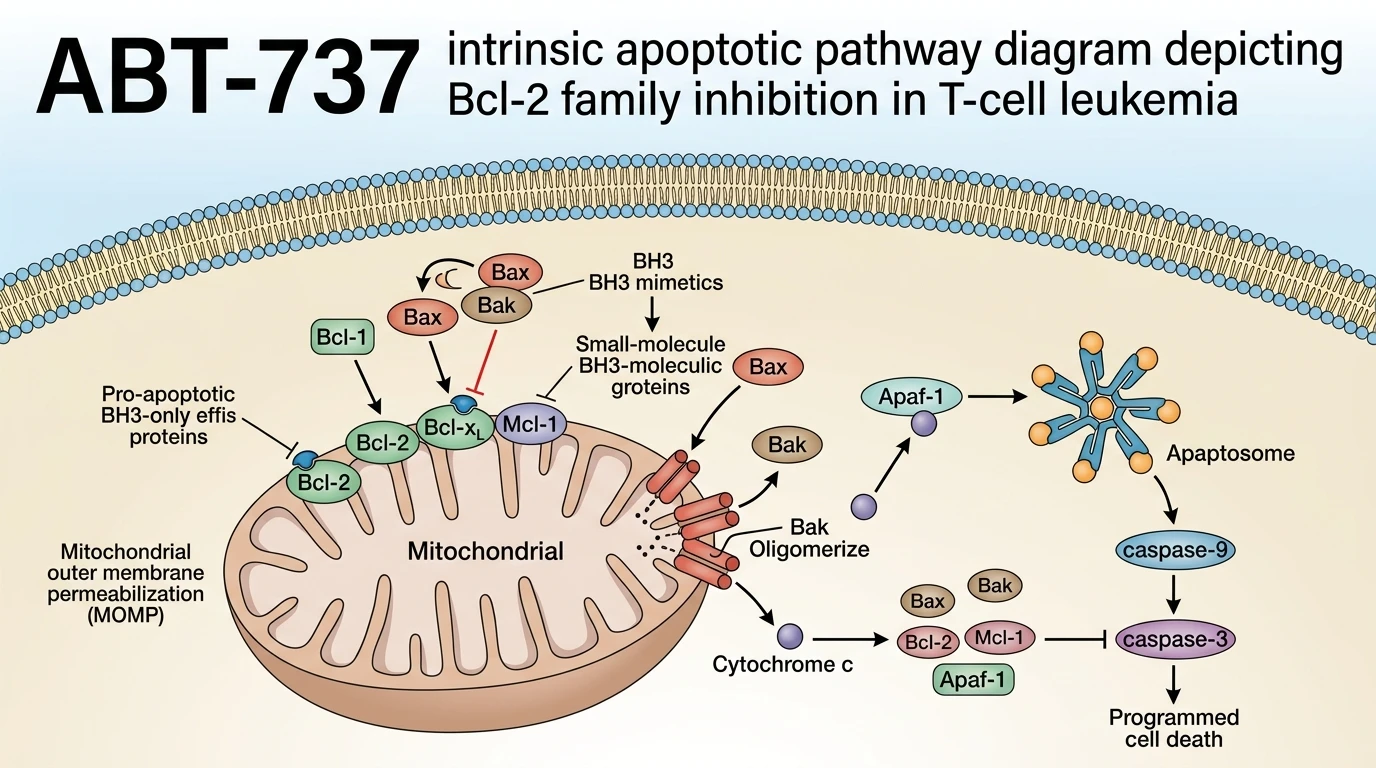
Evasion of programmed cell death represents a primary hallmark of hematologic malignancies, including T-cell acute lymphoblastic leukemia (ALL). Central to this survival phenotype is the dysregulation of the Bcl-2 family of anti-apoptotic proteins. The small-molecule compound ABT-737 was engineered as a high-affinity BH3 mimetic that targets Bcl-2, Bcl-xL, and Bcl-w with low nanomolar binding constants. By Occupying the hydrophobic BH3-binding groove of these anti-apoptotic targets, the ABT737 Bcl-2 inhibitor displaces pro-apoptotic effector proteins such as Bak and Bax. This displacement permits outer mitochondrial membrane permeabilization, cytosolic release of cytochrome c, and subsequent activation of the executioner caspase cascade. Despite this potent biochemical target engagement, single-agent efficacy of ABT-737 is frequently constrained by intrinsic or acquired resistance mechanisms.
Secondary resistance to selective BH3 mimetics stems primarily from the structural selectivity of the inhibitor itself. ABT-737 exhibits minimal binding affinity for myeloid cell leukemia-1 (Mcl-1), a distinct pro-survival member of the Bcl-2 family. Under monotherapy exposure, leukemic cells routinely initiate compensatory transcriptional and translational upregulation of Mcl-1. Elevated Mcl-1 sequester pro-apoptotic BH3-only factors like Bim and Noxa, preventing Bax/Bak oligomerization and maintaining mitochondrial membrane integrity. Consequently, Mcl-1 functions as an operational molecular shield against ABT-737 cytotoxicity. Overcoming this resistance requires combinatorial strategies that concurrently suppress Mcl-1 while maintaining targeted inhibition of Bcl-2 and Bcl-xL.
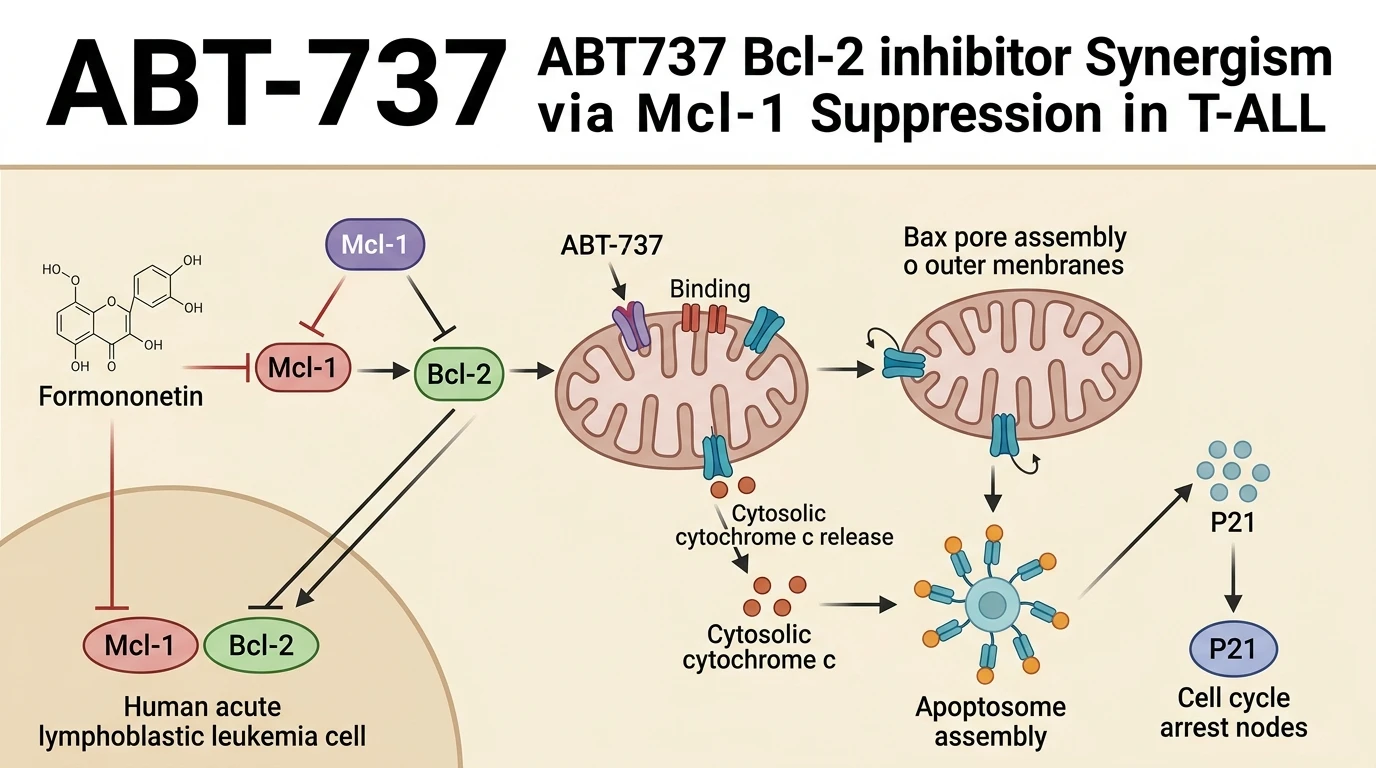
Recent pharmacological evaluations have identified the naturally occurring isoflavone formononetin (biochanin B) as a potent co-therapeutic candidate in T-cell ALL models. In vitro assays using human T-ALL cell lines MOLT-4 and MOLT-17 demonstrate that formononetin modulates multiple nodes within the apoptotic network. When administered as a single agent, formononetin reduces endogenous protein expression of both Bcl-2 and Mcl-1 in a concentration-dependent manner. Concurrently, the compound upregulates pro-apoptotic Bax expression and enhances levels of the cyclin-dependent kinase inhibitor P21 (CDKN1A). This multi-target transcriptional modulation alters the intracellular ratio of pro- to anti-apoptotic proteins in favor of MOMP induction.
When combined with ABT-737, formononetin effectively neutralizes the primary resistance node. By blocking the compensatory accumulation of Mcl-1, formononetin reinstates susceptibility to ABT-737-mediated Bcl-2/Bcl-xL blockade. Quantitative drug-interaction analysis yields combination index (CI) values significantly below 1.0 across multiple effective dose fractions. This strong synergy manifests as a dramatic leftward shift in the concentration-response curves for both agents, lowering the required IC50 values by several-fold relative to monotherapy baselines. In these T-ALL model systems, the dual regimen accelerates mitochondrial depolarization, cleavage of poly(ADP-ribose) polymerase (PARP), and execution of apoptosis, validating formononetin as a viable chemosensitizing partner for BH3-mimetic therapy.
Pharmacological Synergy and Resistance Neutralization in Leukemia
Copy code to add this image to your page
ABT-737 functions as a BH3-mimic targeting Bcl-2 and Bcl-xL to trigger mitochondrial apoptosis. However, secondary resistance arises through compensatory upregulation of Mcl-1. Formononetin counters this survival response by downregulating Mcl-1 and Bcl-2 while upregulating pro-apoptotic Bax and cyclin-dependent kinase inhibitor P21. In MOLT-4 and MOLT-17 T-cell ALL models, co-administration lowers the required inhibitory concentrations of both compounds. This dual-targeted approach produces potent apoptotic synergy (combination index < 1), successfully overcoming Mcl-1-mediated evasion of apoptosis under tested cellular assay conditions.
Formononetin Downregulates Mcl-1 and Reestablishes Mitochondrial Permeabilization
Monotherapy with the ABT737 Bcl-2 inhibitor selectively neutralizes Bcl-2 and Bcl-xL complexes. However, survival signaling persists through uninhibited Mcl-1 activity. Formononetin directly suppresses Mcl-1 protein expression in MOLT-4 and MOLT-17 leukemia models. Reduced Mcl-1 availability frees executioner proteins Bak and Bax from sequestration. Mitochondrial outer membrane permeability increases rapidly. Cytochrome c leaks into the cytosol, driving downstream apoptosome assembly under tested assay conditions.
Combinatorial Regimen Enhances P21 Expression and Apoptotic Flux
Co-treatment lowers effective inhibitory concentrations of both molecules. Combination index evaluations consistently yield CI values below unity, reflecting robust operational synergy. Formononetin drives expression of P21 alongside Bax induction. Cell cycle progression halts at critical checkpoints while apoptotic cascades proceed uninhibited. Cellular viability assays confirm pronounced growth inhibition in patient-derived T-ALL cell lines.