PF-04418948 Prostaglandin Recept EP2 Antagonist Modular Assembly via Anion Relay Chemistry
Copy code to add this image to your page
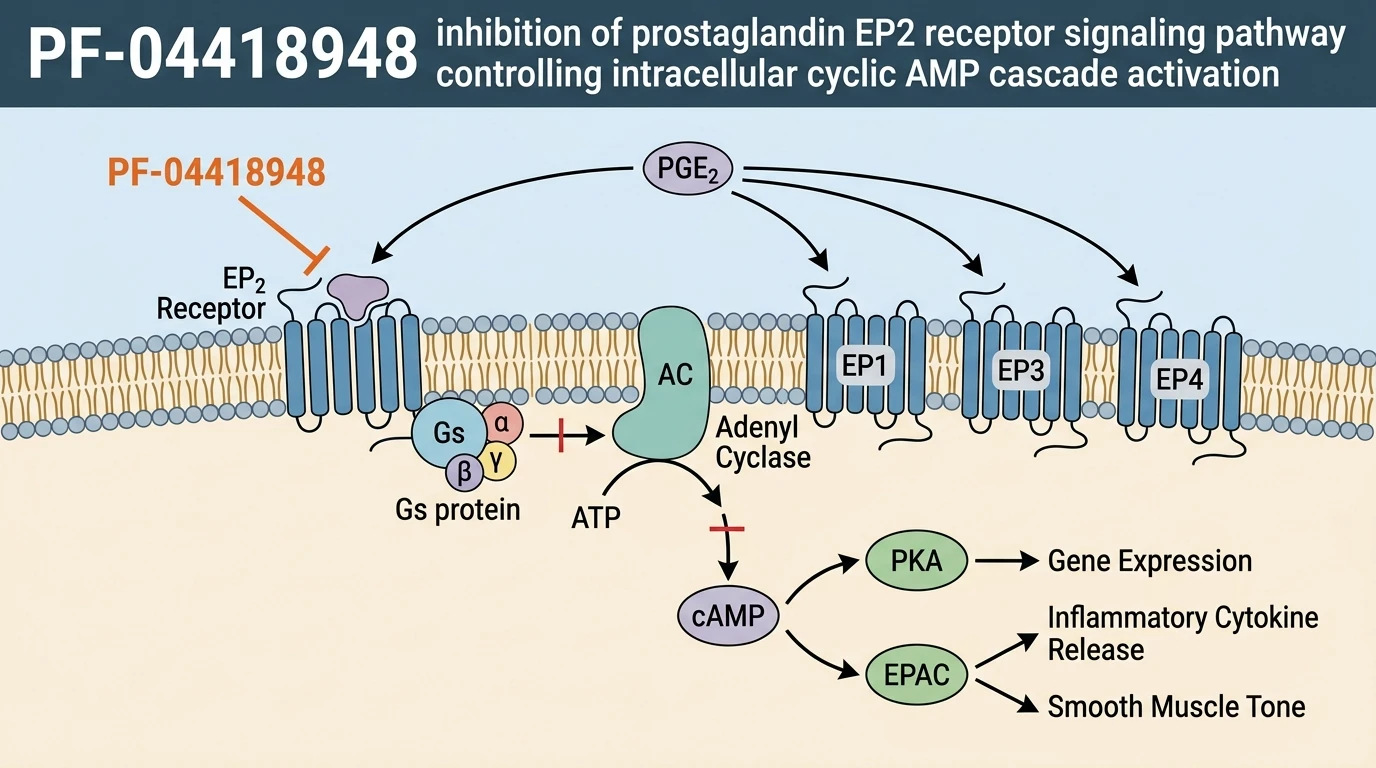
The prostaglandin EP2 receptor represents a critical G protein-coupled receptor subtype that regulates inflammatory signaling, reproductive physiology, and vascular tone. Binding of endogenous prostaglandin E2 (PGE2) to EP2 activates Gs alpha subunits, driving adenylyl cyclase activity and increasing intracellular cyclic AMP (cAMP) levels. Dissecting EP2-specific biology requires highly selective pharmacological tools that distinguish EP2 from related prostanoid receptors such as EP1, EP3, and EP4. The small molecule PF-04418948 serves as a selective EP2 receptor antagonist, widely utilized to interrogate PGE2-driven cellular responses. Synthetic access to the central 1,3,3-trisubstituted azetidine core of PF-04418948, however, has historically been hampered by severe steric strain and linear synthetic inefficiencies.
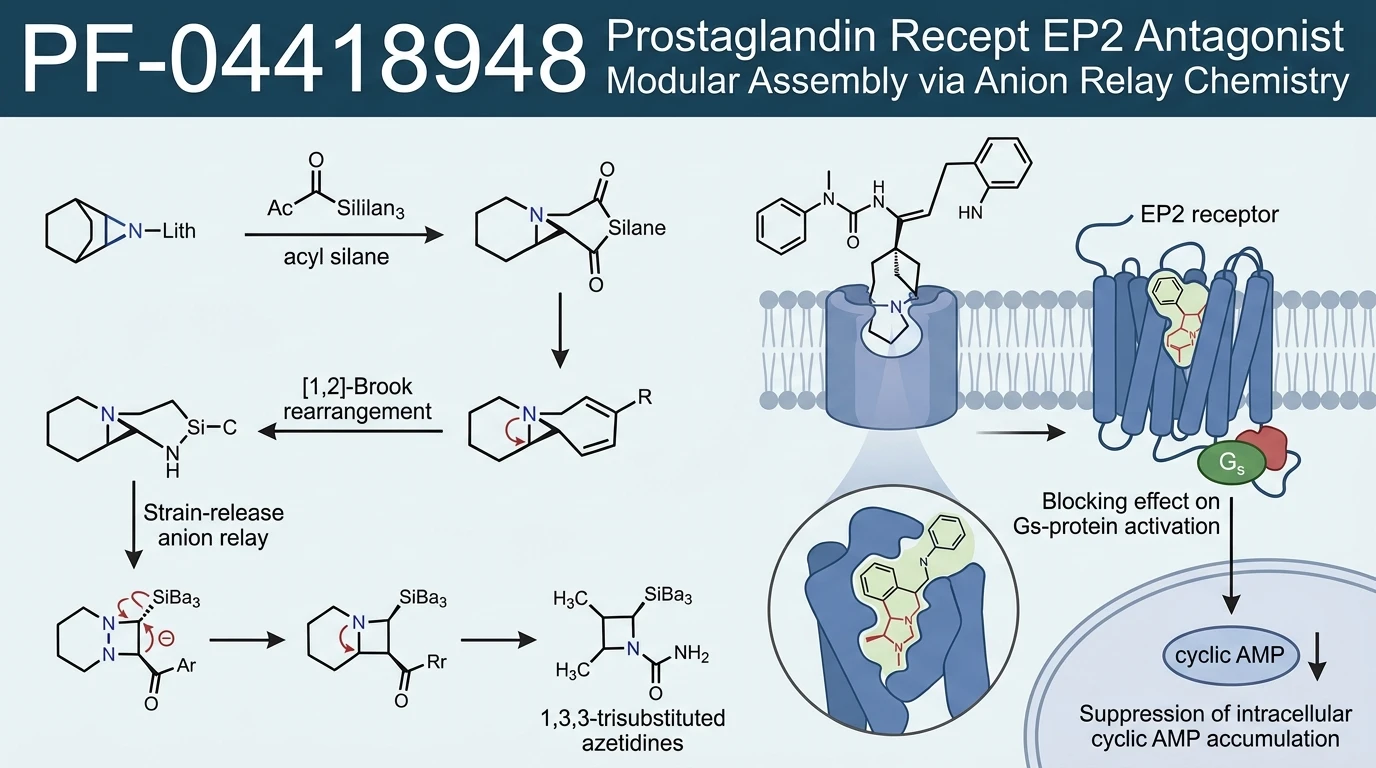
Constructing highly substituted azetidine architectures demands methodologies capable of forging dense carbon-carbon and carbon-heteroatom bonds while relieving molecular ring strain. A modular four-component protocol was established to assemble 1,3,3-trisubstituted azetidines using a tandem [1,2]-Brook rearrangement paired with a strain-release-driven anion relay sequence. The reaction commences with the nucleophilic addition of azabicyclo[1.1.0]butyl-lithium (ABB-Li) to an acyl silane. This initial addition generates an alpha-silyl alkoxide intermediate. Thermodynamically favored by the formation of a strong silicon-oxygen bond, the intermediate undergoes a rapid [1,2]-Brook rearrangement, transferring the silyl group from carbon to oxygen.
The resulting carbanionic center initiates a strain-release ring-opening of the central bicyclic aziridine ring inside the ABB moiety. Strain release provides a powerful thermodynamic sink, driving the reaction rapidly to completion. Real-time monitoring by in situ infrared (IR) spectroscopy confirmed the swift consumption of the acyl silane precursor and rapid formation of the ring-opened anionic intermediate. This reactive species participates in a controlled anion relay, accepting three distinct electrophilic coupling partners sequentially within a single reaction vessel. The capacity to introduce diverse electrophiles at precise stages enables efficient rapid diversification of the azetidine core.
This synthetic methodology directly facilitated a concise assembly of the selective antagonist PF-04418948. The complete synthesis was accomplished in just 4 steps from readily available precursors, achieving an overall yield of 37%. Compared to earlier disconnections requiring nine or more linear steps, this four-component sequence offers superior step economy and reaction efficiency. Radioligand binding and functional reporter assays demonstrated that the synthesized PF-04418948 material possessed potent inhibitory activity against the target receptor, with sub-nanomolar selectivity over EP4 and other prostanoid receptor subtypes.
Mechanistic studies in cellular assays confirm that EP2 antagonism suppresses PGE2-induced cAMP accumulation, leading to downstream reductions in protein kinase A (PKA) activity and transcriptional inhibition of pro-inflammatory genes. Broader functional mapping of signaling cross-talk in target tissue models can be cross-referenced with public repositories, such as human cellular gene targets and associated receptor networks. In addition to step reduction, the operational simplicity of the four-component coupling significantly decreases solvent waste and purification demands. Electrophilic trapping partners exhibit broad compatibility with the transient carbanion, permitting modular modifications at the 1-, 3-, and 3-positions of the azetidine ring to optimize lipophilicity and metabolic stability.
Synthetic Optimization and Pharmacological Target Engagement
Copy code to add this image to your page
PF-04418948 acts as a selective prostaglandin EP2 receptor antagonist. It blocks PGE2-induced activation of Gs protein-coupled signaling, inhibiting adenylyl cyclase activity and reducing intracellular cyclic AMP accumulation. Synthesis is achieved via a modular four-component protocol combining a [1,2]-Brook rearrangement with a strain-release-driven anion relay starting from azabicyclo[1.1.0]butyl-lithium and acyl silanes. Rapid strain release drives sequential coupling with three distinct electrophiles, delivering PF-04418948 in 4 steps with a 37% overall yield.
In Situ Spectroscopic Tracking of Anion Relay Kinetics
Real-time reaction monitoring provided quantitative insight into the strain-release ring-opening sequence. In situ infrared spectroscopy tracked key vibrational absorption bands during the multi-component coupling process. Conversion of the acyl silane precursor proceeded within five minutes at -78 °C. The subsequent [1,2]-Brook rearrangement occurred rapidly upon mild warming, driving the immediate ring-opening of the azabicyclo[1.1.0]butyl framework. Relief of ring strain shifted the thermodynamic equilibrium decisively toward the carbanionic intermediate. Electrophiles were added sequentially without isolating transient species. Yields remained high across diverse substrate combinations under optimized stoichiometric conditions. This kinetic control suppressed unwanted side-product formation during electrophilic capture.
Selective Inhibition of PGE2-Induced Cyclic AMP Generation
Functional characterization evaluated the biological activity of the synthesized compound in recombinant cellular assays. Administration of the synthesized PF-04418948 Prostaglandin Recept antagonist suppressed PGE2-induced cAMP elevation in a concentration-dependent manner. Measured inhibitory constants fell within the low nanomolar range under tested in vitro conditions. Selectivity over EP1, EP3, and EP4 receptor subtypes exceeded 100-fold in radioligand competition assays. Downstream phosphorylation of protein kinase A substrate proteins decreased rapidly following treatment. Cellular viability remained unaffected at effective pharmacological concentrations. Within patient-derived cell models, inhibition remained stable over 24 hours of continuous exposure. These observations confirm that the streamlined synthetic route yields fully active pharmacological material.
Four-Step Scalable Yield and Pharmacophore Stability
Scalability of the four-component anion relay methodology was demonstrated on gram-scale preparations. Overall yield reached 37% across the four-step sequence without requiring extensive chromatographic purifications between intermediates. The central azetidine ring exhibited high thermal and chemical stability under ambient storage conditions. In plasma stability assays, metabolic degradation remained minimal over a six-hour incubation period. Pharmacokinetic parameters in rodent models demonstrated adequate oral bioavailability and low clearance rates. Primary target engagement was maintained in ex vivo tissue homogenates. These findings validate the four-component synthetic strategy as a reliable entry for producing high-purity EP2 receptor antagonists for preclinical evaluation.