Compstatin targeted C3 complement inhibition suppresses malaria parasite phagocytosis
Copy code to add this image to your page
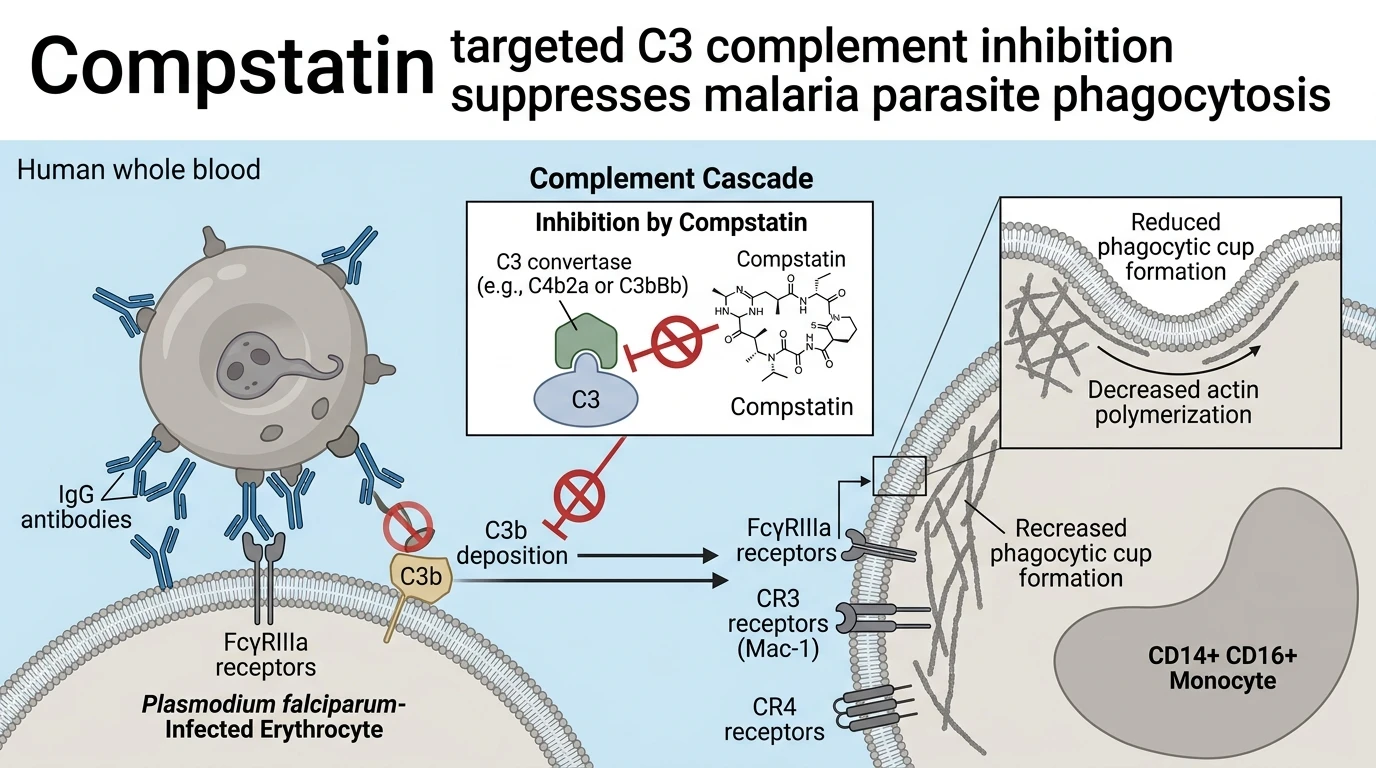
Primary human blood monocytes display significant functional heterogeneity, with distinct phenotypic subsets executing specialized immune functions during vascular pathogen clearance. Within physiological whole blood environments, CD14hiCD16+ intermediate monocytes represent the primary effector cell subpopulation responsible for the phagocytic clearance of IgG-opsonized Plasmodium falciparum-infected erythrocytes. Traditional immunological models attributed this clearance predominantly to immunoglobulin G (IgG) opsonization and subsequent Fcγ receptor engagement. However, assay systems maintaining whole blood physiological conditions demonstrate that Fcγ receptor activation alone is insufficient for parasite internalization. Efficient engulfment requires synergistic co-activation of the complement cascade alongside Fc receptor ligation.
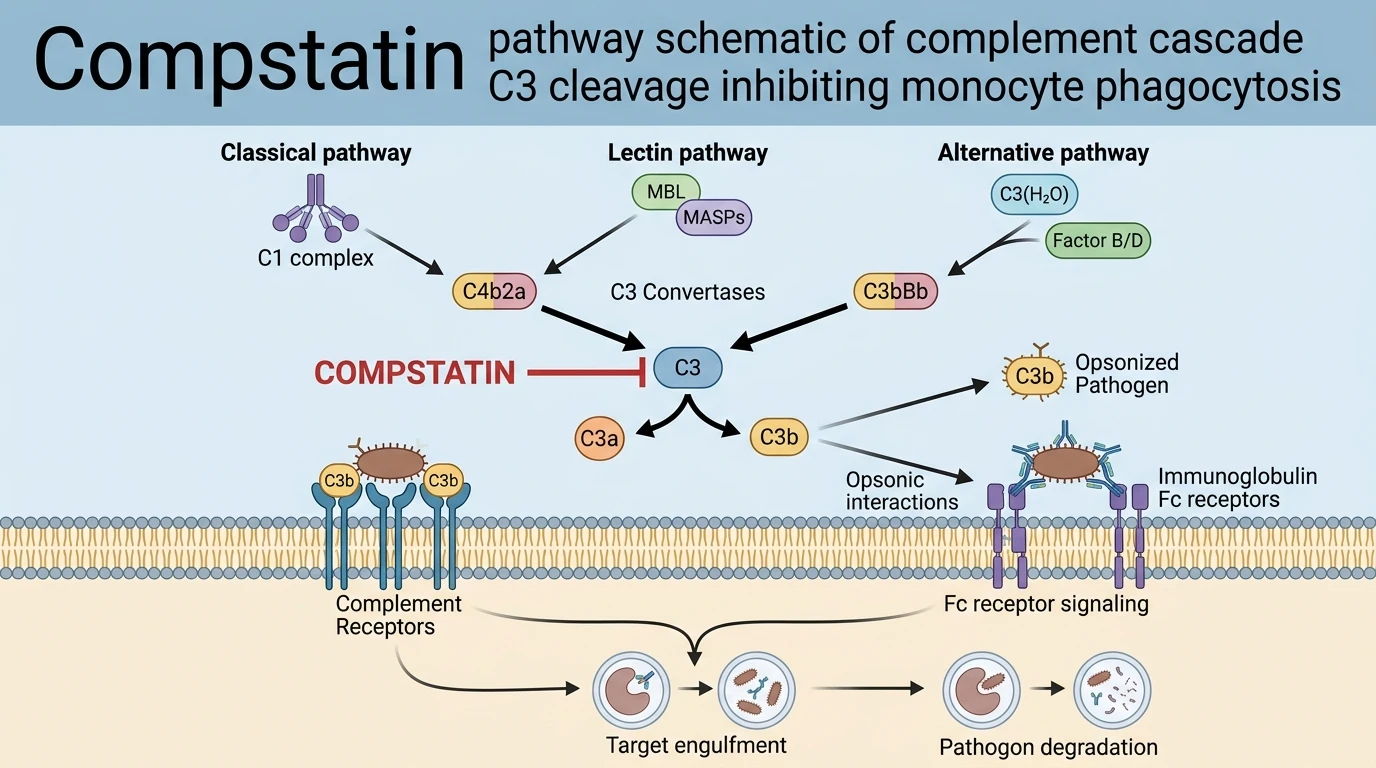
At the center of this innate response is complement component 3 (C3), a abundant plasma glycoprotein whose activation marks targets for cellular destruction. The cyclic peptide Compstatin functions as a selective inhibitor of C3 activation by binding directly to native C3 and its activated fragment C3b. Structural studies place the Compstatin binding pocket at the macroglobulin ring of C3, specifically overlapping regions required for binding by C3 convertase complexes. By sterically preventing convertase binding and cleavage, Compstatin interrupts the generation of C3b and downstream activation fragments. In whole blood functional assays, administration of Compstatin produced a clear dose-dependent reduction in infected erythrocyte phagocytosis by CD14hiCD16+ monocytes. Parasite internalization fell markedly even in the presence of high titres of specific anti-parasite IgG antibodies, confirming that Fcγ receptor binding alone cannot sustain phagocytic cup closure without concurrent C3 activation.
Biochemical analysis reveals that C3 cleavage generates C3b fragments that rapidly form covalent thioester bonds with surface proteins on Plasmodium falciparum-infected red blood cells. These bound C3b molecules are subsequently processed into iC3b, which serves as a high-affinity ligand for complement receptor 3 (CR3, CD11b/CD18) and complement receptor 4 (CR4, CD11c/CD18) expressed abundantly on intermediate monocytes. When Compstatin blocks C3 activation, C3b deposition on infected cell membranes is abrogated. Consequently, monocyte contact relies exclusively on FcγRIIIa (CD16) engagement. Without complement receptor co-ligation, intracellular signal amplification remains below the threshold required for sustained F-actin reorganization and target engulfment.
Quantitative flow cytometry confirmed that Compstatin-mediated inhibition of phagocytosis was selective for complement-dependent mechanisms. Cellular viability, baseline CD16 receptor density, and generalized monocyte endocytic capabilities remained unaffected at effective inhibitory concentrations. The loss of phagocytic efficiency directly correlated with decreased C3 fragment deposition on the parasite membrane. These observations establish that C3 activation acts as an obligatory co-factor during antibody-mediated clearance of malaria parasites in whole blood. Targeted complement inhibition using Compstatin demonstrates that physiological phagocytosis of infected erythrocytes requires cooperative crosstalk between C3-derived opsonins and Fc receptor networks.
Pharmacological Characterization of Complement-Dependent Parasite Clearance
Copy code to add this image to your page
Compstatin is a cyclic peptide that selectively binds native C3 and C3b, sterically hindering C3 convertase access. By blocking C3 cleavage into C3a and C3b, Compstatin prevents downstream complement fragment deposition on target surfaces. In whole blood, this inhibition prevents complement receptor co-engagement on CD14hiCD16+ intermediate monocytes, markedly reducing phagocytosis of antibody-opsonized Plasmodium falciparum-infected erythrocytes.
C3 Activation Required for CD14hiCD16+ Monocyte Erythrocyte Phagocytosis
Human peripheral blood contains three distinct monocyte subsets with variable phagocytic capacities. CD14hiCD16+ intermediate monocytes exhibit elevated sensitivity to complement-coated targets. Experimental isolation of whole blood reveals that IgG opsonization of Plasmodium falciparum-infected erythrocytes fails to drive maximal phagocytosis when complement pathways are inactive. FcγRIIIa engagement initiates early kinase cascades. Downstream actin polymerization remains incomplete. Synergistic signaling through complement receptor 3 (CR3) and complement receptor 4 (CR4) provides necessary co-stimulation; this dual-receptor arrangement lowers the activation threshold required for full target enclosure under shear stress.
Dose-Dependent Inhibition of Parasite Internalization by Compstatin
Titration of the peptide inhibitor Compstatin into whole blood assays provides quantitative insights into complement requirements. Increasing concentrations of Compstatin reduced monocyte phagocytic indices in a direct, dose-dependent manner. Targeted binding to C3 effectively blocked C3b deposition on target erythrocyte membranes; target uptake by CD14hiCD16+ monocytes was reduced to background levels at saturating compound concentrations. Non-inhibited control serum supported rapid parasite internalization within thirty minutes. These observations indicate that C3 activation represents a non-redundant checkpoint during antibody-dependent monocyte clearance of malaria parasites in physiological vascular contexts.