PF-6463922 from Selleck Lorlatinib (PF-6463922) Inhibits ROS1 and ALK Kinases in Refractory NSCLC
Copy code to add this image to your page
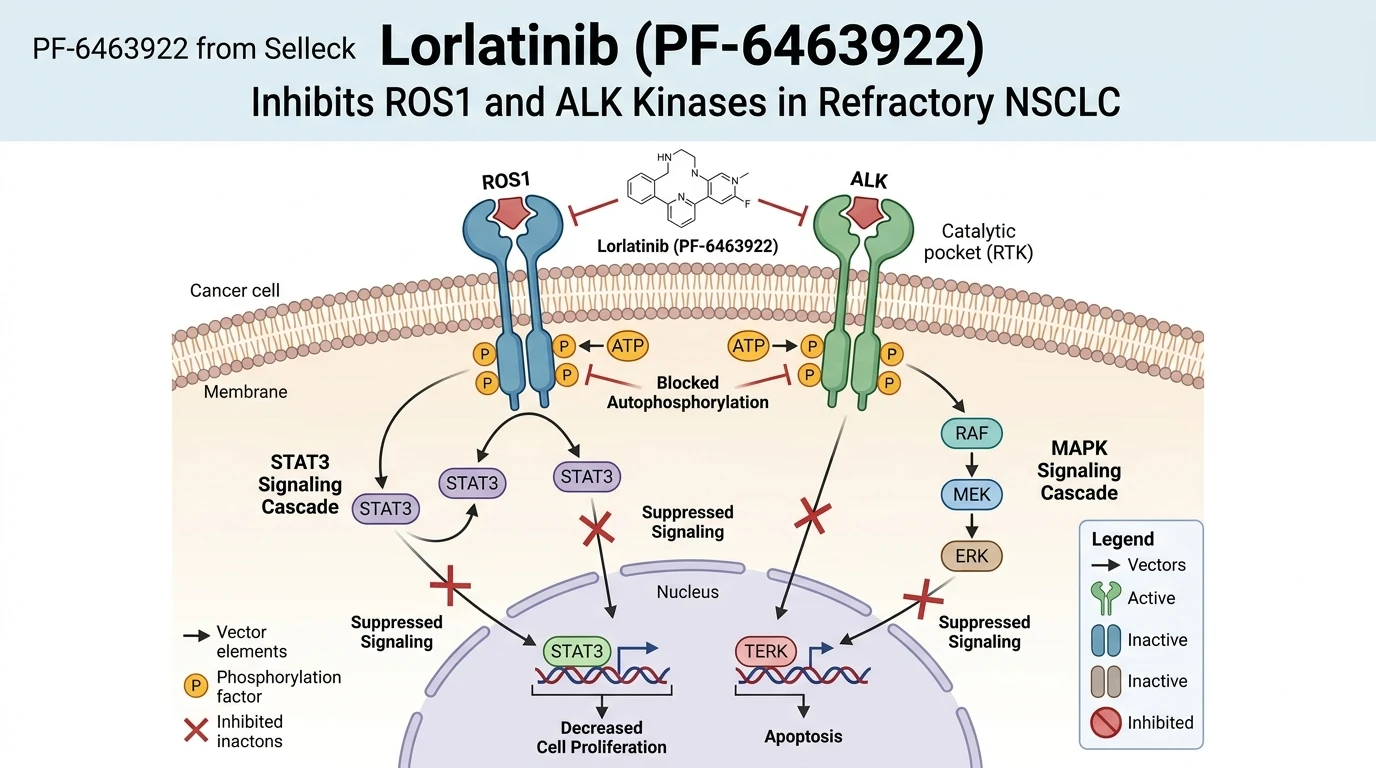
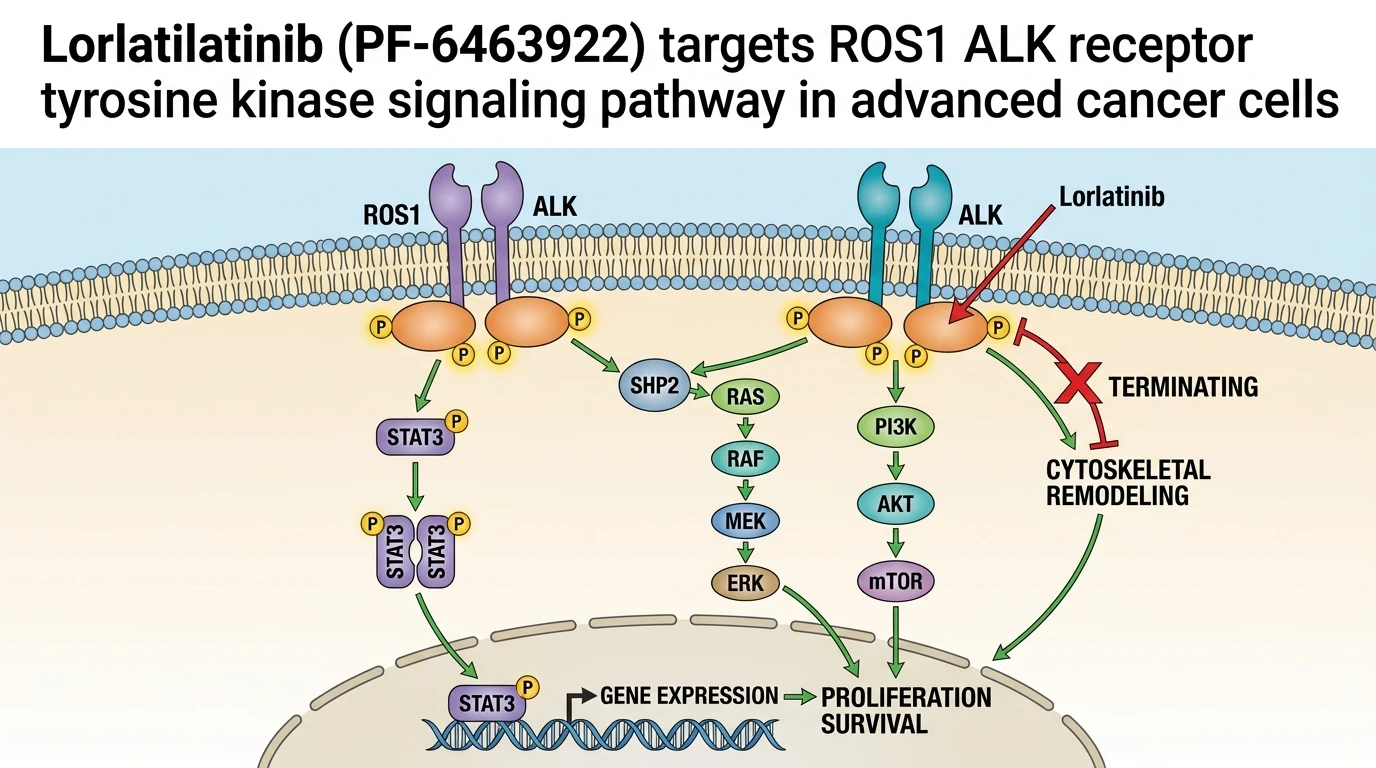
Chromosomal translocations involving the ROS1 and ALK receptor tyrosine kinase genes represent critical oncogenic drivers in non-small-cell lung cancer (NSCLC). In-frame gene fusions—such as CD74-ROS1 or EML4-ALK—encode chimeric protein products featuring constitutively active intracellular kinase domains. Independent of physiological ligand engagement, these chimeric proteins undergo spontaneous dimerization and trans autophosphorylation across critical tyrosine residues. This enzymatic activation triggers downstream signaling nodes, including the STAT3 transcription pathway, SHP2-mediated RAS-RAF-MEK-ERK signaling, and the PI3K-AKT-mTOR axis. Collectively, these intracellular cascades promote uncontrolled cell cycle progression, inhibit apoptosis, and facilitate metastatic cell motility. Although first-generation targeted agents such as crizotinib initially provide notable clinical responses, therapeutic resistance routinely emerges. Secondary mutations occurring within the catalytic kinase domain, alongside intracranial drug failure due to active efflux, present major clinical barriers.
Biochemical characterization reveals that ROS1 shares considerable sequence homology within its kinase domain with ALK, particularly around the ATP-binding cleft. Consequently, point mutations in the solvent front or gatekeeper region induce analogous conformational shifts that reduce drug affinity across both targets. The G2032R mutation in ROS1 introduces a bulky, positively charged arginine side chain that physically obstructs legacy TKIs. Lorlatinib overcomes this kinetic barrier through its compact, cyclic conformation, which fits into the catalytic pocket without requiring major structural displacement of the kinase activation loop. Kinase assay kinetics show nanomolar to sub-nanomolar inhibitory constants against both wild-type and mutant variants. Downstream of kinase inhibition, phosphorylation of STAT3 at Tyr705 and ERK1/2 at Thr202/Tyr204 drops rapidly, arresting cells in the G1 phase of the cell cycle and activating caspase-dependent apoptotic pathways.
Lorlatinib (PF-6463922) was developed as a third-generation, ATP-competitive macrocyclic inhibitor of ROS1 and ALK receptor tyrosine kinases. The macrocyclic scaffold was intentionally synthesized to minimize molecular weight and rotational degrees of freedom, thereby reducing binding entropy and bypassing steric constraints imposed by drug-resistance mutations. Structural analyses using high-purity biological reagents like PF-6463922 from Selleck demonstrate that the compound occupies the ATP-binding pocket with high affinity, forming precise hydrogen bonds along the kinase hinge backbone. Critically, this structural architecture accommodates common solvent-front mutations such as ROS1 G2032R and ALK G1202R, which disrupt the binding of earlier linear inhibitors. Furthermore, lorlatinib exhibits low substrate recognition by P-glycoprotein and breast cancer resistance protein efflux pumps, permitting significant blood-brain barrier penetration and central nervous system accumulation.
Clinical validation of lorlatinib in refractory settings was evaluated in the prospective IFCT-1803 LORLATU trial, which documented therapeutic responses in patients with advanced ROS1+ NSCLC who had failed previous ROS1 TKI therapies. Results recorded in clinical trial registry data and published reports confirmed an overall response rate (ORR) of 45% and a disease control rate (DCR) of 82% across 80 enrolled patients. Intracranial activity was pronounced, yielding a 72% CNS response rate in individuals presenting with baseline central nervous system lesions. The study reported a median progression-free survival (PFS) of 7.1 months and a median overall survival (OS) of 19.6 months calculated from lorlatinib initiation. These outcomes establish that targeted macrocyclic inhibition can alter disease trajectory even after extensive prior treatment failure.
Safety profiles observed during clinical evaluation highlighted manageable off-target and pharmacodynamic toxicities. Grade 3 or higher treatment-related adverse events occurred in 33% of trial participants. Hypercholesterolemia and hypertriglyceridemia represented the most common laboratory abnormalities, arising from targeted modulation of central metabolic signaling nodes. CNS-related adverse effects, including cognitive impairment, mood alterations, and peripheral neuropathy, were also documented. Pharmacological management strategies, such as lipid-lowering co-medications and adaptive dose modifications, maintained therapeutic continuity while mitigating adverse event severity. These clinical metrics position lorlatinib as an effective salvage option for patients with resistant, advanced ROS1-rearranged lung malignancies.
Pharmacological Dynamics and Salvage Efficacy in Refractory Disease
Copy code to add this image to your page
Lorlatinib (PF-6463922) is a potent, macrocyclic, ATP-competitive inhibitor of ROS1 and ALK receptor tyrosine kinases. Designed to penetrate the blood-brain barrier and evade efflux transporters, it maintains binding efficacy against common drug-resistant mutations, including ROS1 G2032R and ALK G1202R. By blocking kinase autophosphorylation, it suppresses downstream STAT3, MAPK, and PI3K-AKT signaling pathways, arresting cell growth and inducing apoptosis in TKI-refractory non-small-cell lung cancer.
Macrocyclic Kinase Engagement Overcomes Solvent-Front Resistance Mutations
High-resolution structural biology demonstrates that macrocyclic design restricts single-bond rotational freedom. This structural rigidity allows PF-6463922 from Selleck to fit into the ATP-binding cassette of ROS1 without establishing unfavorable steric interactions with bulky amino acid side chains. Solvent-front substitutions, such as ROS1 G2032R, introduce charged, space-filling arginine residues that sterically block linear TKIs like crizotinib. Lorlatinib circumvented this steric hindrance under tested in vitro kinase assays and structural models. The inhibitor forms key hydrogen bonds with the kinase hinge region while maintaining low active-state binding free energy. Intracellular signal transduction through phosphorylated ROS1 and downstream STAT3 stopped rapidly following exposure. Cellular viability in resistant mutant lines dropped substantially. The structural adaptation effectively rescues target engagement where earlier drugs fail.
Intracranial Penetration Suppresses Central Nervous System Metastatic Progression
Central nervous system disease progression remains a frequent failure mode during target-directed lung cancer management. Active efflux mediated by P-glycoprotein and breast cancer resistance protein limits the blood-brain barrier permeability of many small-molecule inhibitors. Lorlatinib was optimized to minimize substrate affinity for these ABC transporters. In patient-derived cell models and xenografts, brain tissue concentration closely matched unbound plasma exposure levels. Intracranial target engagement was confirmed by the 72% CNS response rate in the IFCT-1803 cohort. Tumor burden within brain parenchyma decreased markedly under clinical evaluation. However, central nervous system penetration correlates with specific off-target or target-associated neurological toxicities. Cognitive slowing and affective changes were documented in a minority of subjects. Careful monitoring remains clinically necessary during sustained dosing regimens.
Metabolic and Neurological Profiles Define Safety Boundaries in Patients
Safety analyses from the IFCT-1803 trial defined clear management parameters for long-term administration. Grade 3 or higher adverse events occurred in 33% of the evaluated 80 patients. Hypercholesterolemia and hypertriglyceridemia represented the most prominent metabolic shifts. Mechanistic hypotheses suggest these lipid elevations stem from peripheral inhibition of CNS or liver signaling pathways modulating lipid homeostasis. Standard statin therapy successfully controlled hyperlipidemia in most trial participants without requiring permanent drug discontinuation. Neurological symptoms generally proved reversible upon temporary dose interruption or step-down dose modification. Pharmacokinetic exposure remained adequate for kinase suppression even at reduced dosage levels. These empirical observations highlight the necessity of balancing potent therapeutic salvage against manageable metabolic side effects.