AZD5363 (Capivasertib) Pan-AKT Kinase Inhibition in Pathway-Altered Advanced Breast Cancer
Copy code to add this image to your page
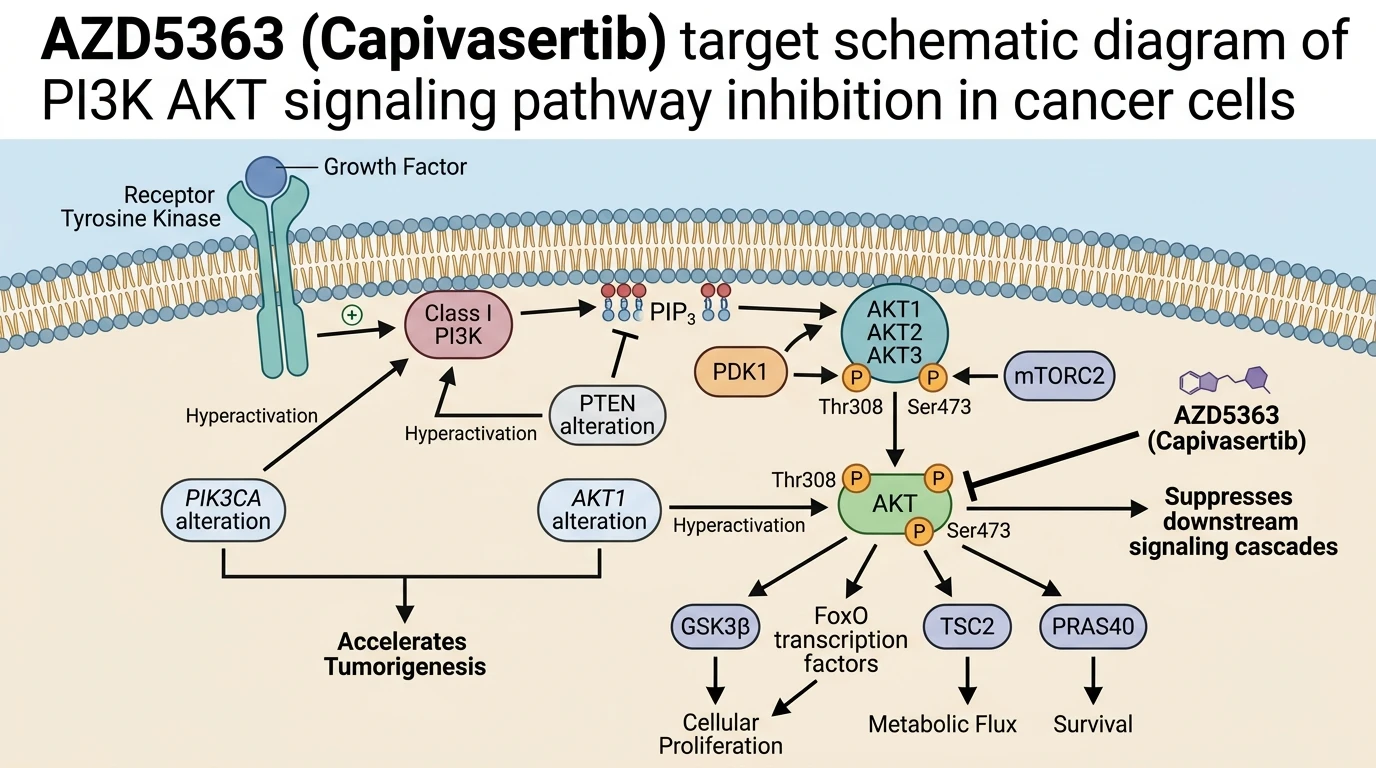
Hyperactivation of the phosphatidylinositol 3-kinase (PI3K)/AKT signal transduction network represents one of the most frequent oncogenic drivers in human malignancies. Among downstream effectors, the serine/threonine kinase AKT serves as a central signaling node, encoded by three distinct genes expressing the AKT1, AKT2, and AKT3 isoforms. Activating somatic mutations in PIK3CA or AKT1, alongside loss-of-function lesions in the tumor suppressor PTEN, induce constitutive AKT phosphorylation. This enzymatic activation drives cell cycle progression, anti-apoptotic cascades, and altered nutrient metabolism across solid tumors.
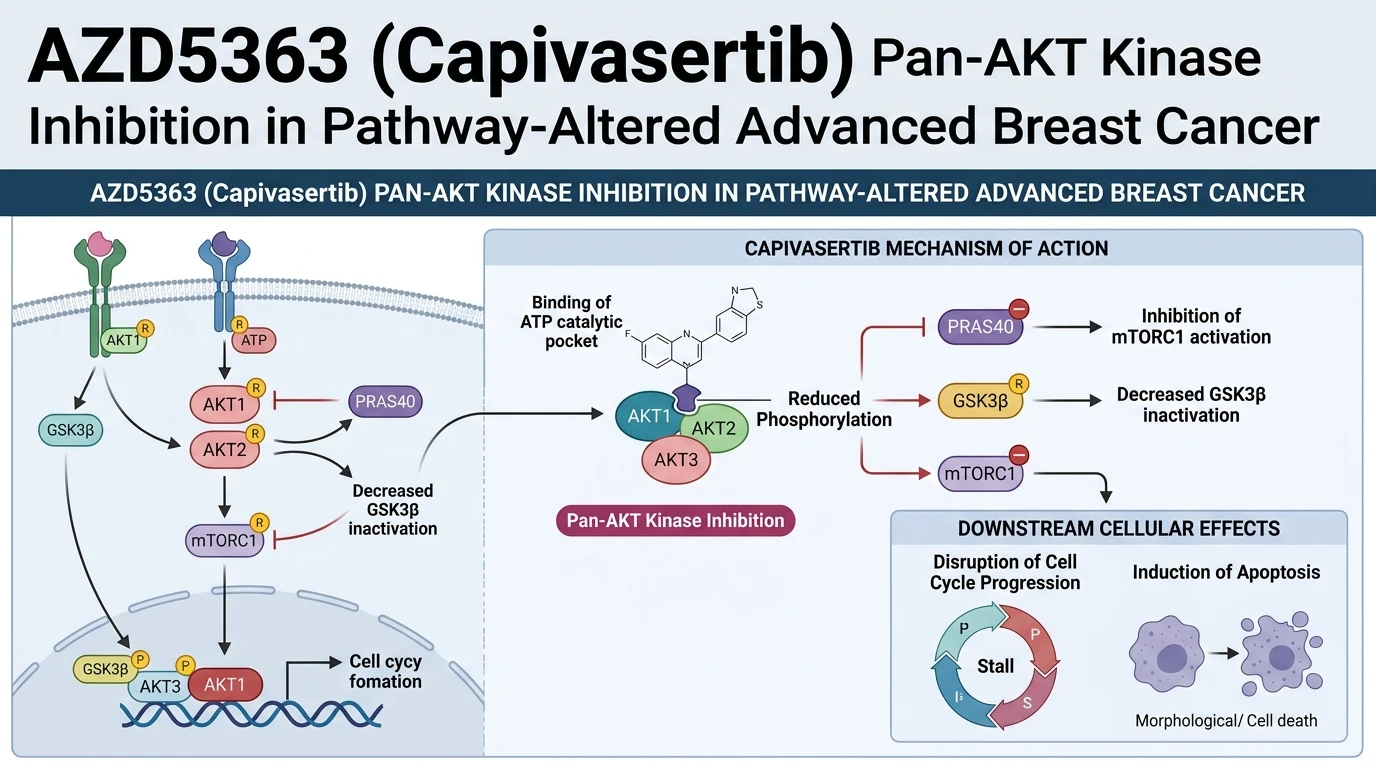
AZD5363 (Capivasertib) functions as a potent, ATP-competitive pan-AKT kinase inhibitor designed to suppress the catalytic activity of all three AKT isoforms with nanomolar affinity in biochemical assays. Mechanistically, capivasertib binds to the active site of AKT1, AKT2, and AKT3, preventing substrate phosphorylation regardless of upstream pathway hyperactivation. Paradoxically, competitive binding by capivasertib induces hyperphosphorylation of AKT at residues Thr308 and Ser473 by blocking intracellular phosphatase access; however, the kinase remains functionally inactive due to persistent active-site occupancy. This catalytic blockade prevents downstream transfer to biochemical targets—including glycogen synthase kinase 3 beta (GSK3β), forkhead box O (FoxO) transcription factors, and proline-rich AKT substrate of 40 kDa (PRAS40). In preclinical models, attenuation of downstream target phosphorylation directly correlates with G1 phase cell cycle arrest and induction of intrinsic apoptosis.
Translational studies established that co-targeting the estrogen receptor and AKT signaling axis creates synthetic lethality in hormone receptor-positive (HR+), human epidermal growth factor receptor 2-negative (HER2-) advanced breast cancer models harboring pathway alterations. Clinical evaluation confirmed that capivasertib in combination with the selective estrogen receptor degrader fulvestrant provides superior progression-free survival compared to single-agent endocrine therapy in patients with HR+/HER2- advanced breast cancer displaying somatic PIK3CA, AKT1, or PTEN alterations. The observed therapeutic benefit confirmed that dual pathway suppression effectively overcomes acquired endocrine resistance mediated by persistent PI3K/AKT signal propagation.
Despite clear antitumor activity, systemic pharmacological blockade of pan-AKT signaling triggers predictable on-target, off-tumor toxicities due to the physiological roles of AKT isoforms in tissue homeostasis. AKT2 primarily regulates insulin-stimulated glucose uptake in skeletal muscle and adipose tissue through GLUT4 translocation. Consequently, pharmacological inhibition of AKT2 disrupts systemic glucose disposition, frequently producing acute hyperglycemia and compensatory hyperinsulinemia. Simultaneously, systemic suppression of AKT1 and AKT3 within dermal and gastrointestinal epithelial structures impairs cell survival and mucosal barrier integrity, resulting in cutaneous adverse reactions—predominantly maculopapular rash—and secretory diarrhea.
Managing these characteristic adverse events requires baseline risk evaluation and early therapeutic protocols. For cutaneous toxicities, prophylactic administration of second-generation H1-antihistamines reduces the incidence and severity of capivasertib-induced skin eruptions. When managing metabolic dysregulation, baseline screening of glycated hemoglobin (HbA1c) identifies patients at elevated risk for severe hyperglycemia; early initiation of metformin therapy, alongside dietary modifications, stabilizes plasma glucose levels without compromising antineoplastic efficacy. Diarrhea management relies on step-wise intervention starting with early loperamide administration, adequate oral rehydration, and dietary adjustments. When severe toxicities emerge, protocol-guided dose interruptions and step-wise dose reductions maintain long-term therapeutic exposure, allowing patients to continue treatment while minimizing adverse impacts on clinical outcomes.
Therapeutic Evaluation and Pharmacological Characterization of Capivasertib
Copy code to add this image to your page
Capivasertib is a potent ATP-competitive pan-AKT kinase inhibitor targeting AKT1, AKT2, and AKT3 isoforms. By occupying the ATP catalytic pocket of AKT, capivasertib blocks phosphorylation of downstream effector substrates, including GSK3β, FoxO transcription factors, and PRAS40, suppressing mTORC1 signaling, cell cycle progression, and cellular survival. In tumors harboring PIK3CA, AKT1, or PTEN alterations, it restores sensitivity to endocrine therapy.
Isoform-Nonselective Catalytic Blockade Attenuates Downstream Signaling Cascades
Biochemical characterization demonstrates that AZD5363 inhibits recombinant AKT1, AKT2, and AKT3 enzymes with half-maximal inhibitory concentrations in the low nanomolar range under cell-free assay conditions. Upon cellular entry, the molecule occupies the ATP-binding pocket of all three catalytic domains. Downstream target phosphorylation ceased rapidly following drug exposure. Specifically, levels of phosphorylated PRAS40 at Thr246 and phosphorylated GSK3β at Ser9 decreased significantly within two hours of treatment in sensitive cancer cell lines. While upstream feedback loops lead to accumulation of Ser473-phosphorylated AKT, the active site remains occupied by the inhibitor, preventing substrate turnover. Consequently, signaling flux through the mammalian target of rapamycin complex 1 (mTORC1) path declines, leading to marked dephosphorylation of 4E-BP1 and S6 ribosomal protein. This profound suppression of protein translation apparatus culminates in cellular growth inhibition across diverse pathway-mutated tumor models.
On-Target Metabolic and Epithelial Toxicities Define Clinical Safety Parameters
Because AKT isoform activity regulates physiological homeostasis across non-malignant tissues, pan-AKT inhibition produces distinct physiological side effects. Inhibition of peripheral AKT2 blocks insulin-dependent glucose transporter type 4 (GLUT4) translocation to cell membranes. As a consequence, peripheral glucose clearance drops rapidly, inducing transient hyperglycemia in clinical trial subjects. Concurrent suppression of mucosal and epidermal AKT signaling leads to altered keratinocyte differentiation and intestinal epithelial barrier degradation. Clinical trial data indicate that grade 3 or higher diarrhea and maculopapular rash occur in a notable subset of patients receiving full-dose combination therapy. Prophylactic treatment regimens involving H1-receptor antagonists significantly lower the severity of cutaneous reactions. Likewise, early metformin initiation effectively manages blood glucose elevations, preserving therapeutic continuity.
Biomarker-Driven Patient Stratification Optimizes Progression-Free Survival Outcomes
Retrospective genomic analysis of clinical trial cohorts confirms that therapeutic efficacy correlates strongly with specific oncogenic alterations within the PI3K/AKT node. Patients presenting with activating PIK3CA mutations, functional AKT1 E17K substitutions, or inactivating PTEN alterations experienced enhanced progression-free survival benefits when treated with the capivasertib-fulvestrant combination. In contrast, tumors lacking identifiable driver mutations within this axis exhibited modest responses. The selectivity margin between anti-tumor efficacy and systemic toxicity remains narrow. Careful patient selection using next-generation sequencing assays ensures that only populations with verified pathway hyperactivation undergo treatment. Furthermore, implementing predefined dose adjustment schedules mitigates treatment-emergent adverse events without compromising systemic drug exposure or clinical efficacy.