Selonsertib (GS-4997) from Selleck targets ASK1 signaling in steatotic liver disease
Copy code to add this image to your page
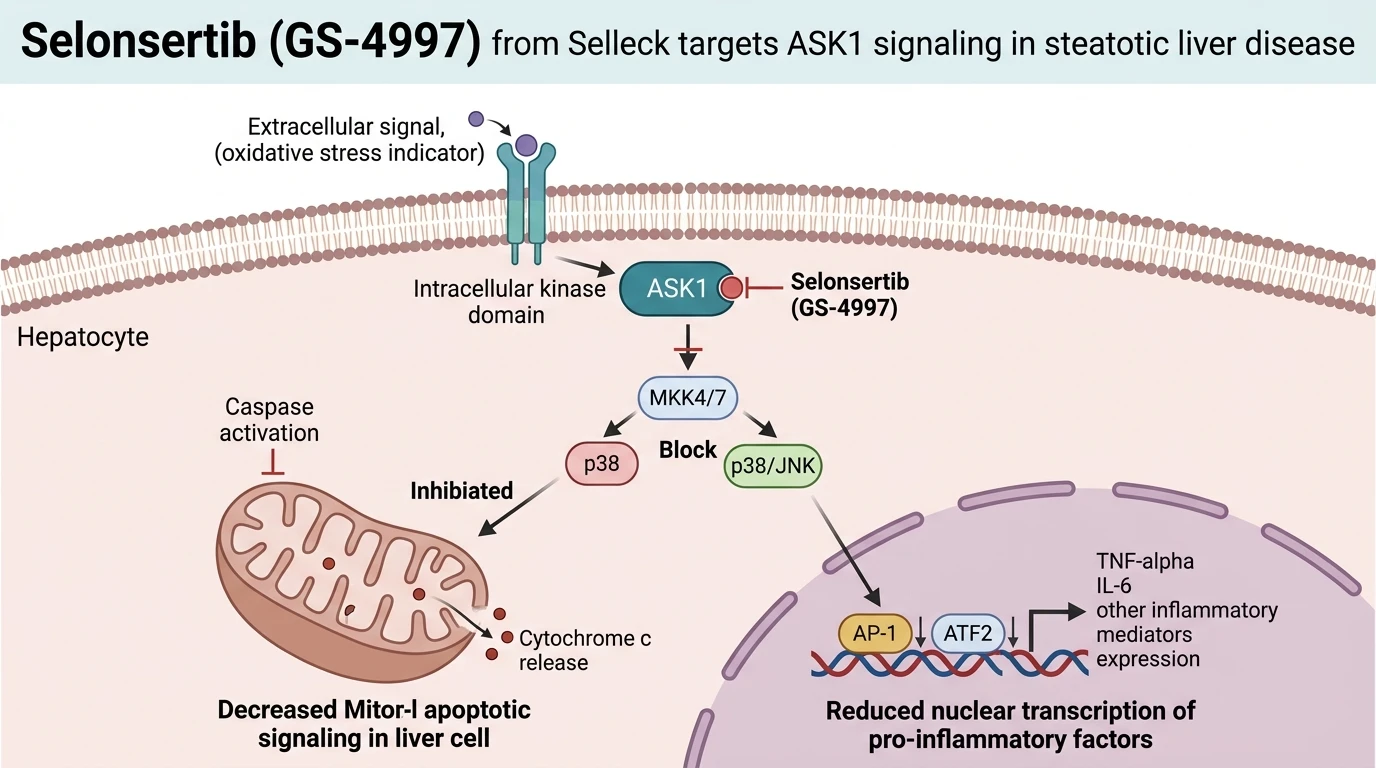
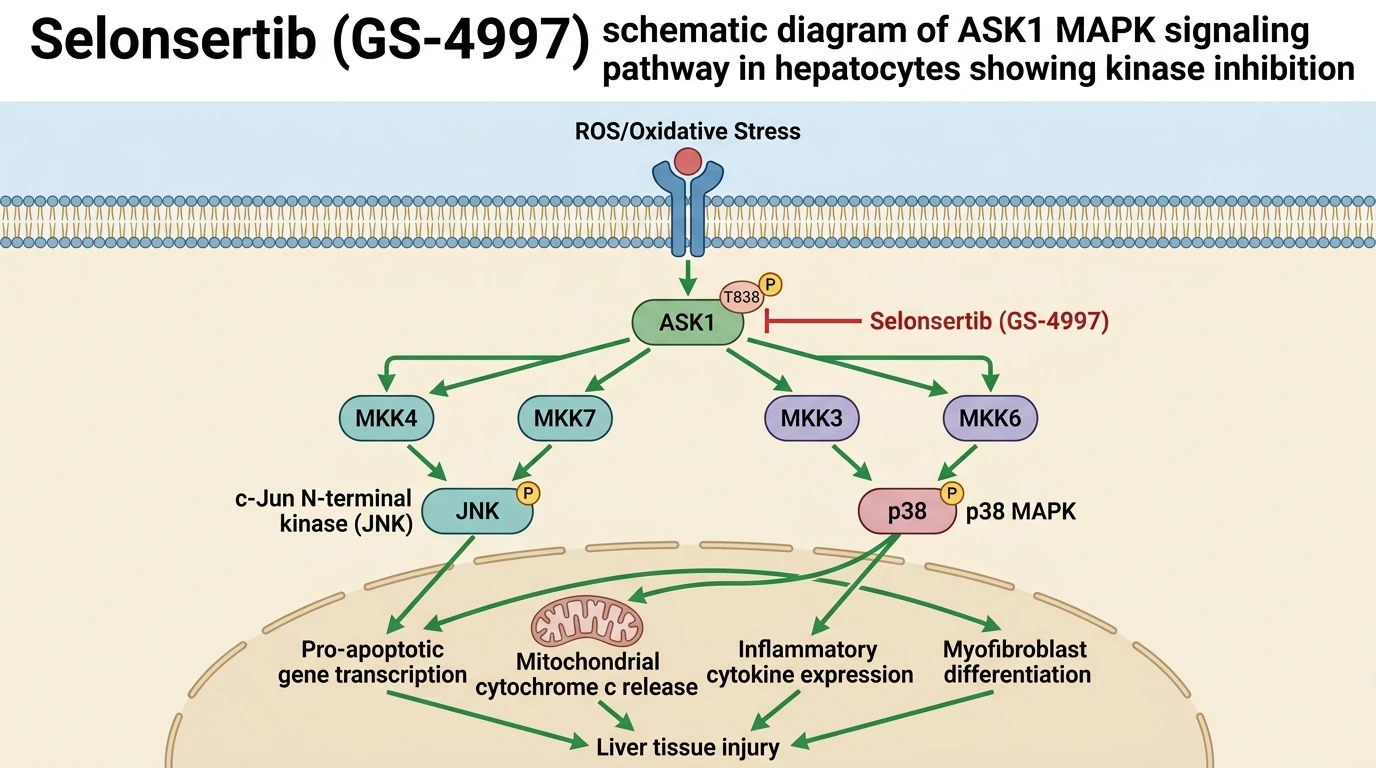
Apoptosis signal-regulated kinase-1 (ASK1), encoded by the MAP3K5 gene, represents a Ser/Thr kinase positioned at the apex of stress-responsive signaling pathways. Intracellular reactive oxygen species (ROS), endoplasmic reticulum stress, and inflammatory cytokines such as TNF-α stimulate the dissociation of thioredoxin from the N-terminal regulatory domain of ASK1. This dissociation triggers homooligomerization and autophosphorylation at Threonine 838 within the activation loop. Activated ASK1 selectively phosphorylates dual-specificity mitogen-activated protein kinase kinases, specifically MKK4 and MKK7, alongside MKK3 and MKK6. These intermediate nodes propagate catalytic activation to c-Jun N-terminal kinase (JNK) and p38 MAPK, culminating in AP-1 transcription factor activation, mitochondrial cytochrome c release, and execution of hepatocyte death programs.
In chronic liver pathologies, including metabolic dysfunction-associated steatotic liver disease (MASLD) and severe alcoholic steatohepatitis (MetALD/ASH), persistent lipid accumulation and oxidative flux induce chronic ASK1 signaling. This persistent activation accelerates hepatocyte ballooning, inflammatory cytokine secretion (IL-1β, IL-6, TNF-α), and paracrine activation of hepatic stellate cells into collagen-secreting myofibroblasts. Selonsertib (GS-4997) was developed as an oral, highly selective, ATP-competitive inhibitor targeting the catalytic kinase domain of ASK1. Biochemical kinase assays established that GS-4997 from Selleck inhibits ASK1 catalytic activity with low nanomolar potency, demonstrating exquisite selectivity over related MAP3K family members, including MEKK1, TAK1, and ASK2.
Initial preclinical investigations across rodent models of diet-induced steatohepatitis demonstrated that selective ASK1 inhibition effectively attenuated hepatic steatosis, immune cell infiltration, and pericellular fibrosis. In primary hepatocyte cultures subjected to palmitate-induced lipotoxicity, cellular treatment suppressed autophagy and apoptotic death cascades upon ASK1 blockade. Early-phase open-label human trials aligned with these mechanistic observations. In a Phase II trial involving patients with non-alcoholic steatohepatitis (NASH/MASLD) and stage 2 or 3 fibrosis, administration of Selonsertib (GS-4997) at 6 mg or 18 mg daily for 24 weeks produced measurable reductions in hepatic fibrosis stage, as assessed by magnetic resonance elastography and paired liver biopsy histology. Furthermore, treated cohorts demonstrated significant decreases in serum liver transaminases (ALT, AST) and systemic biomarkers of cell death, such as cytokeratin-18 (CK-18) fragments.
Despite these encouraging Phase II biomarker trajectories, subsequent phase III definitive trials failed to confirm histological efficacy. The multinational STELLAR-3 and STELLAR-4 trials evaluated Selonsertib (GS-4997) in patients with MASLD presenting with bridging fibrosis (stage F3) and compensated cirrhosis (stage F4), respectively. Neither trial achieved its primary endpoint of a ≥1-stage improvement in liver fibrosis without worsening of NASH at week 48. In STELLAR-4, 14.4% of patients receiving 18 mg selonsertib achieved fibrosis improvement compared to 12.8% in the placebo cohort, a difference lacking statistical significance. Similarly, in STELLAR-3, responder rates were 12% in the 18 mg arm versus 16% in the placebo group.
Parallel clinical evaluation in severe alcoholic steatohepatitis yielded comparable neutral outcomes. In a randomized Phase II trial of patients with severe ASH, combining selonsertib with standard-of-care prednisolone failed to improve 28-day or 90-day survival compared to prednisolone monotherapy. Biopsy analyses revealed no significant reduction in hepatic inflammation or hepatocyte ballooning attributable to ASK1 inhibition. Consequently, clinical development programs evaluating selonsertib for MASLD and severe ASH have been formally terminated.
Clinical Evaluation and Pharmacological Translation of ASK1 Inhibition
Copy code to add this image to your page
Selonsertib (GS-4997) is an oral ATP-competitive inhibitor of apoptosis signal-regulated kinase-1 (ASK1). By selectively binding the kinase domain of ASK1, it prevents autophosphorylation at Threonine 838 and suppresses downstream activation of MKK4, MKK7, MKK3, and MKK6. This block halts signal transduction through c-Jun N-terminal kinase (JNK) and p38 MAPK networks, thereby blunting pro-apoptotic transcription, proinflammatory cytokine expression, and hepatic stellate cell activation in steatotic liver injury.
Phase III STELLAR Cohorts Exhibit No Anti-Fibrotic Progression
Primary endpoint analysis in the STELLAR-4 phase III trial evaluated patients with F4 compensated cirrhosis. Treatment arms received 6 mg or 18 mg daily. Histological responder rates remained statistically indistinguishable from placebo controls. Only 14.4% of high-dose subjects met the primary endpoint. The placebo response rate reached 12.8%. Similarly, trial STELLAR-3 targeted F3 bridging fibrosis without demonstrating anti-fibrotic progression. Responders comprised 12% of the 18 mg treatment cohort. Biochemical transaminase levels declined slightly, yet structural tissue remodelling remained absent. Utilizing GS-4997 from Selleck in human clinical cohorts underscored severe translation discrepancies between animal models and advanced human cirrhosis.
Combined Prednisolone Regimens Fail in Severe Alcoholic Steatohepatitis
Severe alcoholic steatohepatitis presents high short-term mortality driven by inflammatory liver failure. Research evaluated whether targeting oxidative kinase nodes enhances corticosteroid response. A phase II trial combined prednisolone with daily oral kinase inhibition. Non-responders showed elevated systemic markers of necrosis. Survival at day 28 reached 88% in the combination cohort. Prednisolone monotherapy demonstrated an identical 89% survival profile. Histological inflammation scores remained unaltered across biopsy samples. Experimental utilization of GS-4997 from Selleck revealed no additive benefit over standard steroid therapy alone.
Redundant MAP3K Signaling Nodes Limit Single Kinase Monotherapy
Functional redundancy within intracellular MAP3K signaling pathways frequently limits monotherapy efficacy. Hepatocyte stress responses recruit multiple parallel catalytic nodes. Transforming growth factor-beta-activated kinase 1 (TAK1) compensates for isolated ASK1 blockade. Similarly, MEKK1 signaling maintains downstream p38 phosphorylation during sustained lipid toxicity. In vitro hepatocyte assays confirm that targeting a single stress kinase triggers compensatory transcriptional upregulation of parallel MAP3K isoforms. Cellular survival networks remain resilient. Effective therapeutic intervention in metabolic liver disease may require dual pathway suppression.