MNK Inhibitors
MAP kinase-interacting kinases (MNKs), comprising MNK1 and MNK2, are a family of serine/threonine kinases that serve as critical downstream effectors of the MAPK (ERK and p38) signaling pathways. Upon activation by upstream MAPKs, MNKs primarily phosphorylate the eukaryotic initiation factor 4E (eIF4E) at serine 209. This phosphorylation event enhances eIF4E's affinity for the 5' cap of messenger RNA (mRNA), thereby promoting the cap-dependent translation of specific mRNAs. These mRNAs often encode oncogenes, growth factors, anti-apoptotic proteins, and other factors critical for cell proliferation, survival, and angiogenesis, such as c-Myc, Cyclin D1, VEGF, and survivin. Beyond eIF4E, MNKs also phosphorylate other substrates, including heterogeneous nuclear ribonucleoproteins (hnRNPs) and RNA-binding proteins, suggesting broader roles in RNA metabolism and gene expression regulation. The MNK-eIF4E axis is a crucial node in controlling protein synthesis, particularly under conditions of stress or aberrant signaling. Dysregulation and hyperactivation of the MNK-eIF4E pathway are frequently observed in a wide array of human cancers, including acute myeloid leukemia (AML), breast cancer, lung cancer, prostate cancer, and melanoma.
In these malignancies, enhanced eIF4E phosphorylation contributes to increased translation of oncogenic proteins, promoting tumor initiation, progression, metastasis, and resistance to conventional therapies. Furthermore, MNKs are activated by inflammatory cytokines (e.g., TNF-α, IL-1β) and play a role in the production of pro-inflammatory mediators, implicating them in inflammatory and autoimmune diseases. Emerging evidence also suggests their involvement in neurological disorders, including synaptic plasticity and neurodegeneration. Given their central role in promoting disease, MNK inhibitors have garnered significant interest as potential therapeutic agents. Research into MNK inhibitors is predominantly in the preclinical stage, with a few compounds having progressed to early clinical trials. Most MNK inhibitors are ATP-competitive small molecules that bind to the kinase domain, preventing its catalytic activity. Early research tools like CGP57380 and cercosporamide demonstrated the therapeutic potential of MNK inhibition in preclinical cancer models by selectively suppressing the translation of oncogenic mRNAs.
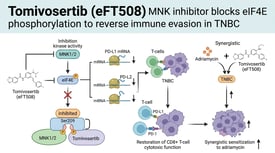
More recently, compounds like eFT508 (tomivosertib) have advanced significantly, entering clinical trials for various solid tumors and lymphomas. Tomivosertib, a potent and selective MNK1/2 inhibitor, aims to reduce eIF4E phosphorylation and thereby inhibit the translation of key oncogenic drivers. Other compounds with diverse chemical scaffolds, including pyrazoles, quinolines, and indazoles, are also under active investigation. MNK inhibitors can be classified as pan-MNK inhibitors (targeting both MNK1 and MNK2) or isoform-selective inhibitors, and by their binding mode (Type I/II ATP-competitive). Key challenges include achieving high selectivity over other kinases to minimize off-target effects and toxicity, and fully elucidating the spectrum of MNK substrates beyond eIF4E. Combination therapy strategies are a major focus, as MNK inhibitors can synergize with other targeted therapies (e.g., mTOR inhibitors to achieve more comprehensive suppression of cap-dependent translation, or MAPK pathway inhibitors) and conventional chemotherapies to overcome resistance and enhance anti-tumor efficacy. The phosphorylation of eIF4E at Ser209 serves as a valuable pharmacodynamic biomarker to assess target engagement.
The unique mechanism of targeting mRNA translation offers a distinct therapeutic avenue, complementing existing strategies that focus on transcription or protein stability, making MNK inhibitors a promising class of drugs for cancer and inflammatory diseases.