SC79 from Selleck Activates Akt Kinase to Restore Hematopoietic Stem Cell Metabolism
Copy code to add this image to your page
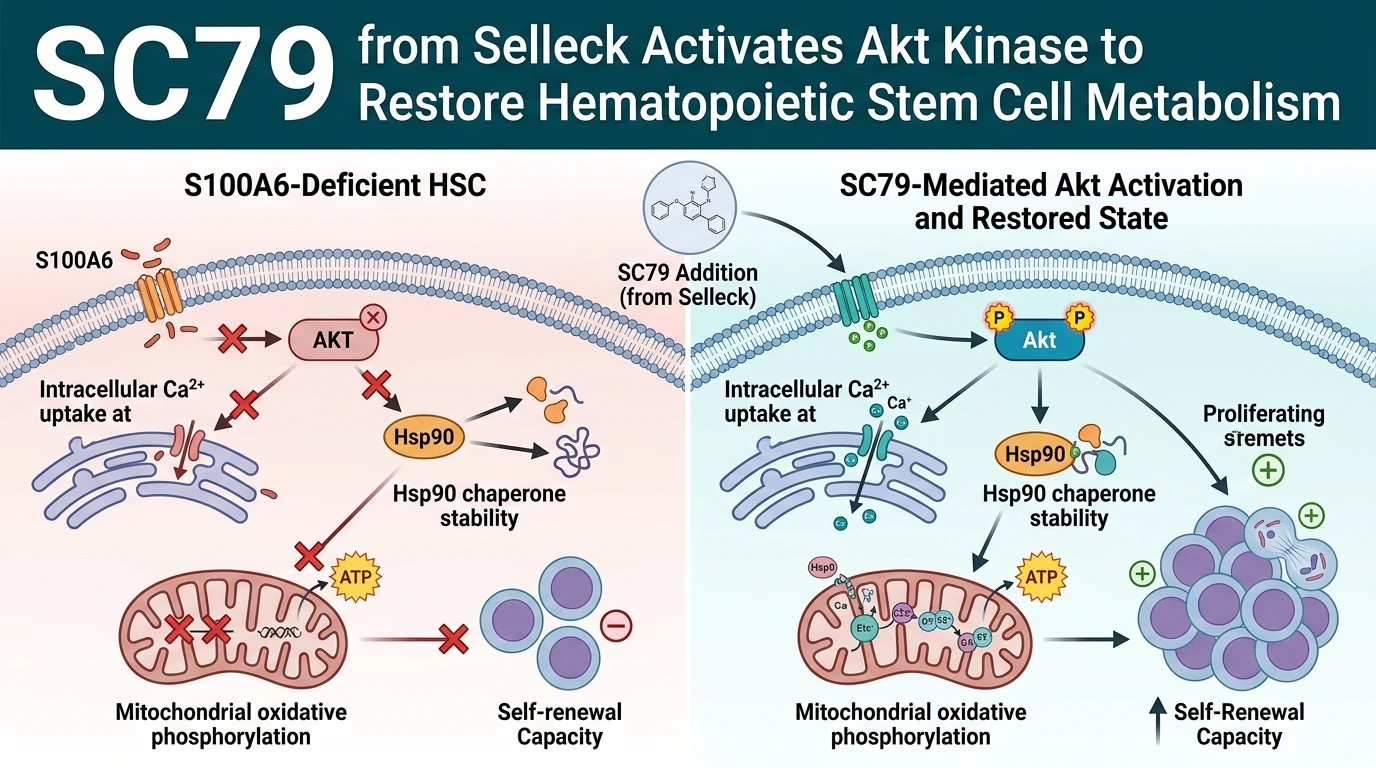
Hematopoietic stem cell (HSC) longevity and operational self-renewal demand tight coordination between intracellular signaling cascades and mitochondrial energy metabolism. Within the bone marrow niche, quiescent stem cells maintain metabolic equilibrium, balancing glycolytic fluxes with inducible mitochondrial oxidative phosphorylation to sustain long-term reconstituting capacity. Recent empirical investigations identified S100A6—a low-molecular-weight EF-hand calcium-binding protein—as a critical regulator governing HSC fate choices, survival, and organelle function. Experimental knockout models reveal that S100A6 deficiency induces severe bioenergetic failure characterized by impaired cytosolic calcium dynamics and attenuated mitochondrial calcium import. Reduced matrix calcium concentrations impair key rate-limiting dehydrogenases, leading to compromised oxidative phosphorylation rates, reduced oxygen consumption, and reduced ATP generation.
At the biochemical level, loss of S100A6 destabilizes the downstream serine/threonine kinase Akt (Protein Kinase B). In wild-type stem cells, activated Akt phosphorylates diverse effector proteins that regulate cell survival, translation, and organelle cross-talk. In S100A6-deficient HSCs, baseline phosphorylated Akt (p-Akt at Ser473 and Thr308) levels fall sharply. This signaling deficit cascades down to the heat shock protein 90 (Hsp90) chaperone network, where diminished phosphorylation reduces Hsp90 stability and client protein binding. Consequently, structural enzymes and mitochondrial maintenance factors undergo misfolding or accelerated degradation, compounding metabolic insufficiency.
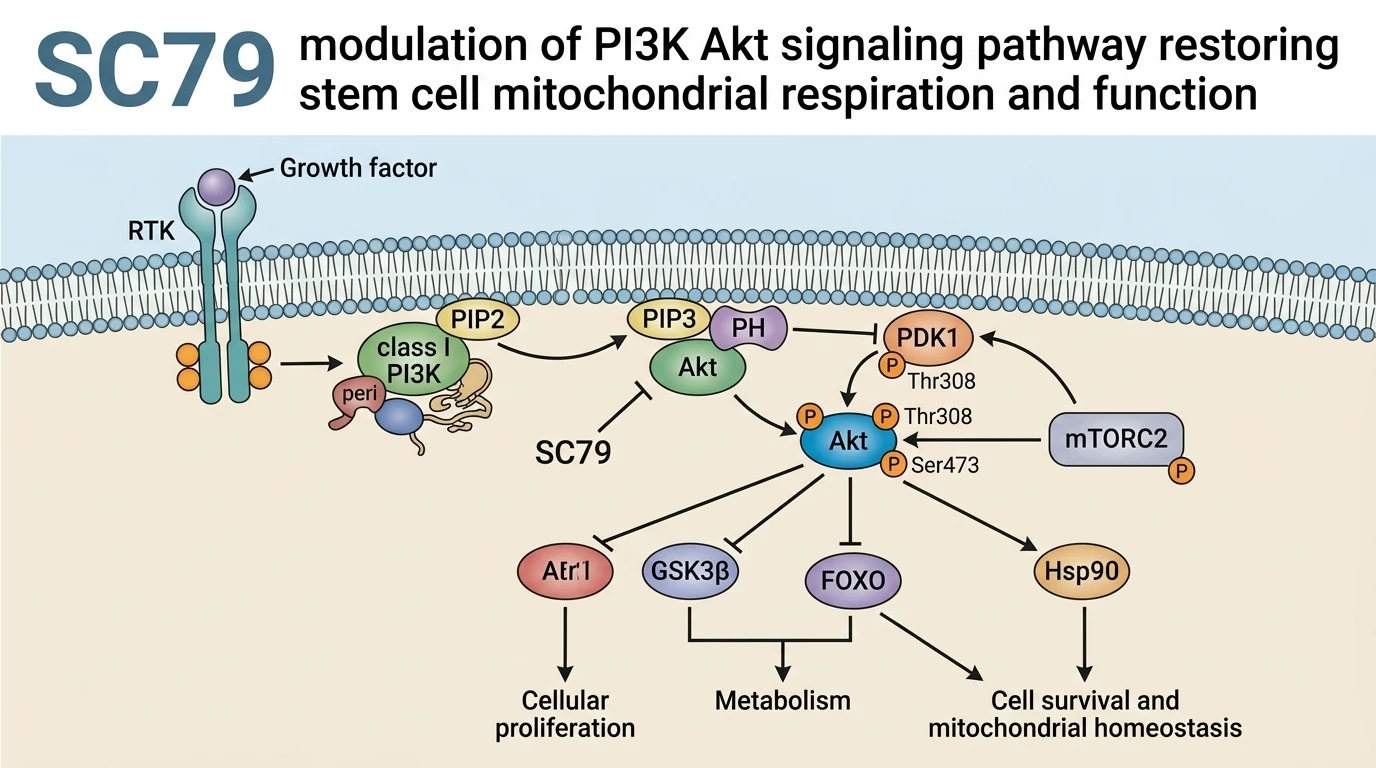
To evaluate whether direct target activation could override S100A6 loss, researchers utilized SC79, a small-molecule Akt activator. SC79 binds selectively to the pleckstrin homology (PH) domain of Akt. This binding event alters protein conformation, facilitating kinase phosphorylation by upstream regulatory kinases even in the absence of canonical PIP3 membrane recruitment. Applied to S100A6-knockout primary HSC cultures at physiologically relevant micromolar concentrations, SC79 from Selleck effectively reactivated Akt catalytic function. Direct phosphorylation of Akt Ser473 restored signal propagation through the target axis.
Pharmacological activation of Akt by SC79 from Selleck initiated rapid restoration of intracellular calcium transport mechanics. Restored cytosolic calcium levels enabled active ion import into the mitochondrial matrix through the mitochondrial calcium uniporter complex. Matrix calcium recovery restored pyruvate dehydrogenase activity, re-establishing oxygen consumption rates and normalizing cellular mitochondrial ATP production. Concurrently, SC79-mediated Akt activation restored Hsp90 chaperone function, protecting downstream structural substrates from degradation. In primary hematopoietic progenitor colony-forming assays, treatment with SC79 fully recovered colony-forming unit (CFU) capacity in S100A6-null HSCs, matching wild-type benchmark levels.
These observations confirm that S100A6 operates as an indispensable upstream module regulating HSC fate choices through the PI3K-Akt signaling pathway. Chemical activation via SC79 directly rescues mitochondrial bioenergetics, chaperone stability, and stem cell self-renewal capacity, illustrating the therapeutic utility of targeting node-specific kinase kinetics in metabolic stem cell dysfunction models.
The molecular architecture of S100A6 features two canonical EF-hand motifs that undergo conformational shifts upon binding intracellular calcium ions, facilitating selective interactions with target cytoskeletal elements and cytosolic signaling enzymes. In S100A6-deficient conditions, the absence of calcium-bound S100A6 compromises the assembly of signaling complexes necessary for baseline Akt recruitment and subsequent activation. The synthetic molecule SC79 circumvents this biological requirement by directly stabilizing the active open conformation of Akt in the cytosol. By enforcing this active state independently of membrane-bound phosphoinositide interactions or S100A6 scaffold activity, SC79 restores substrate phosphorylation kinetics across multiple downstream target proteins. This target-specific pharmacological intervention demonstrates that key stem cell metabolic parameters remain dynamically flexible and responsive to targeted small-molecule kinase modulation.
Assessment of mitochondrial ROS accumulation further highlighted the bioenergetic rescue mediated by chemical Akt activation. S100A6-knockout stem cells exhibited elevated mitochondrial superoxide generation alongside impaired mitochondrial membrane potential. Treatment with SC79 reduced excessive reactive oxygen species production, preserving mitochondrial structural integrity and preventing premature stem cell exhaustion during serial transplantation assays.
Pharmacological Target Engagement and Metabolic Restoration
Copy code to add this image to your page
SC79 acts as a direct, cell-permeable small-molecule Akt activator. Upon entering the cell, SC79 binds directly to the pleckstrin homology domain of Akt, inducing a conformational change that promotes phosphorylation at Thr308 and Ser473. This activation bypasses upstream membrane receptor requirements, restoring downstream phosphorylation of Hsp90, enhancing cytosolic and mitochondrial calcium uptake, and recovering mitochondrial oxidative phosphorylation and self-renewal in S100A6-deficient hematopoietic stem cells.
Restoration of Mitochondrial Calcium Import and Oxidative Phosphorylation
S100A6 deficiency impairs mitochondrial bioenergetics in stem cells. Under observed experimental conditions, loss of S100A6 markedly decreased cytosolic calcium levels while simultaneously dampening mitochondrial matrix calcium accumulation. ATP production rates declined sharply. Mechanistic profiling demonstrated that treatment with the Akt activator SC79 from Selleck effectively restored intracellular calcium uptake dynamics in knockout models. Respiratory capacity reached wild-type baseline levels. The drug binding enhanced Akt Ser473 phosphorylation, thereby promoting downstream mitochondrial uniporter activation without altering resting basal membrane potential.
Chaperone Stabilization and Hematopoietic Colony Formation Recovery
Downstream chaperone function depends on active kinase activity. In S100A6-deficient hematopoietic stem cells, reduced phosphorylated Akt concentrations directly precipitated a decline in active Hsp90 chaperone complexes. Colony-forming capacity dropped significantly. Administration of SC79 bypassed upstream S100A6 signaling deficits, driving direct activation of Akt and stabilizing Hsp90 client protein interactions. Progenitor self-renewal capacity was preserved. These cellular observations confirm that targeted pharmacological activation of Akt can substitute for upstream regulatory proteins in maintaining stem cell stemness.