Ipatasertib (GDC-0068) suppresses flavivirus replication via ATP-competitive Akt kinase inhibition
Copy code to add this image to your page
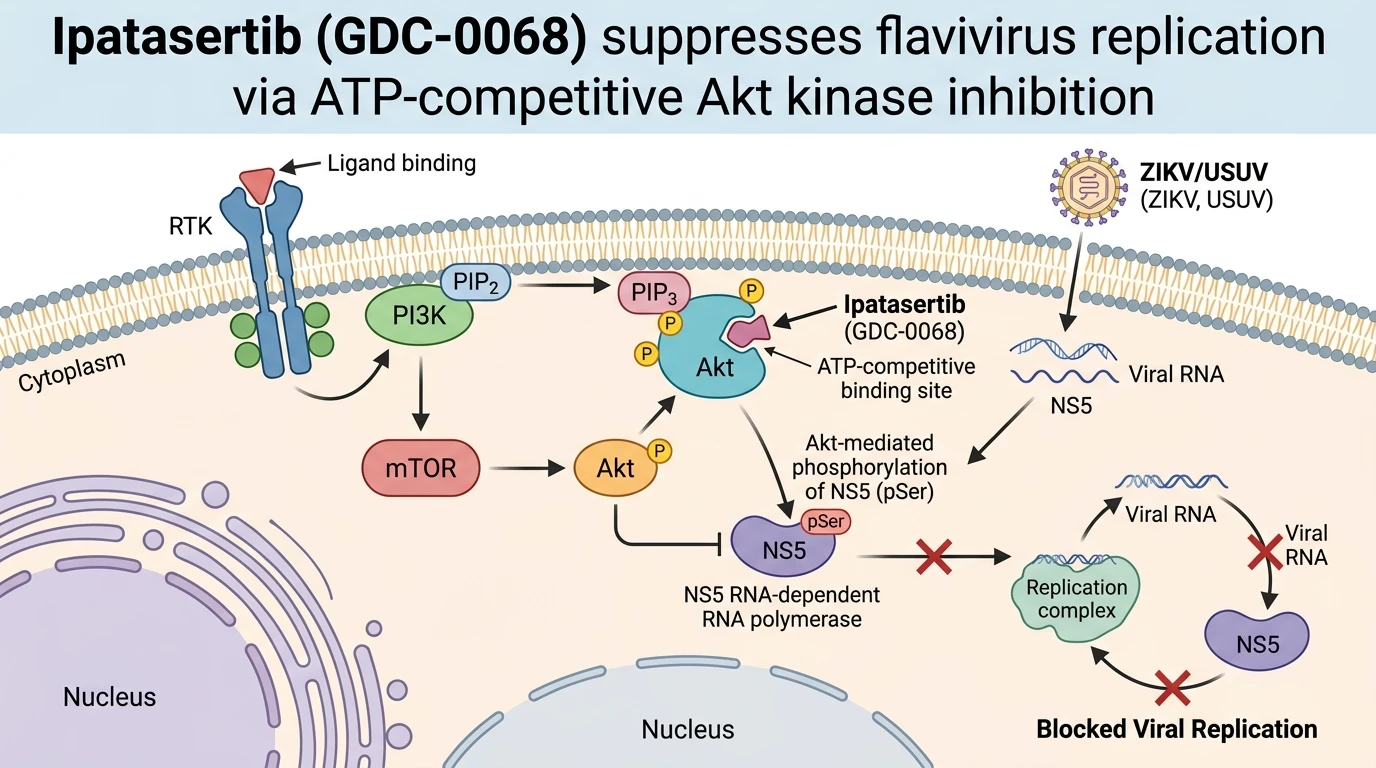
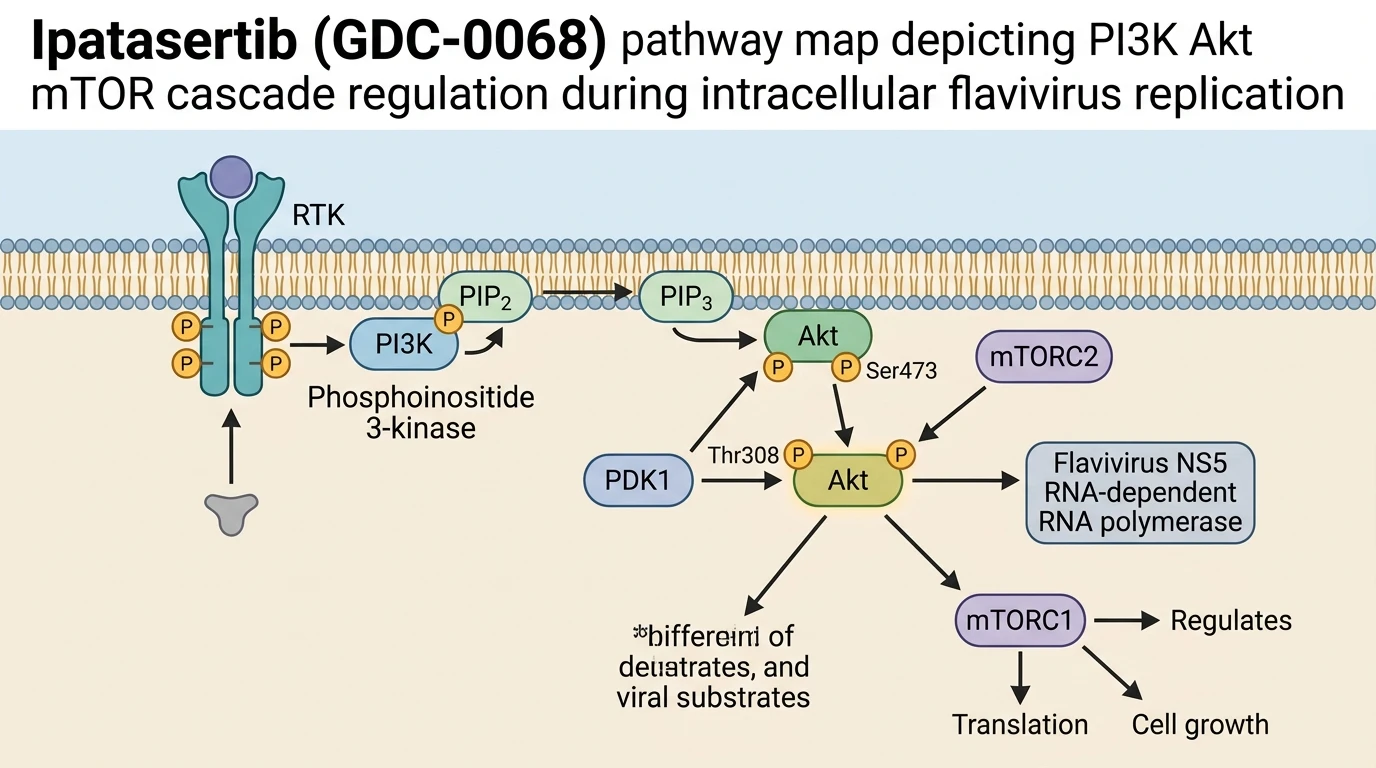
Host-directed antiviral strategies seek to disrupt cellular machinery required for viral propagation, offering a high barrier to viral resistance. Among targetable host pathways, the serine/threonine kinase Akt (Protein Kinase B / PKB)—a central effector of the phosphoinositide 3-kinase (PI3K)/Akt/mammalian target of rapamycin (mTOR) signaling axis—serves as a crucial regulatory hub for cellular homeostasis and viral co-optation. Members of the Flaviviridae family, including Zika virus (ZIKV) and Usutu virus (USUV), rely extensively on host cell signaling machinery to complete their life cycles. Biochemical characterization reveals that Akt directly interacts with and phosphorylates the flavivirus NS5 RNA-dependent RNA polymerase (RdRp). This post-translational modification targets a highly conserved catalytic serine residue within the NS5 protein architecture, modulate viral polymerase activity, and influences RNA synthesis kinetics.
Pharmacological inhibition of Akt presents a viable avenue to suppress viral replication by interrupting host-mediated post-translational modification of viral machinery. Ipatasertib (GDC-0068) is a potent, selective, ATP-competitive small-molecule inhibitor of Akt isoforms (Akt1, Akt2, and Akt3). By binding directly to the ATP-binding cleft in the active kinase domain, Ipatasertib prevents catalytic phosphate transfer to down-stream substrates. In cell culture models infected with ZIKV or USUV, application of Ipatasertib produces a robust, dose-dependent decrease in viral progeny yield. Quantitative analysis demonstrates that targeting Akt via Ipatasertib disrupts the precise phosphorylation dynamics of NS5, thereby compromising viral genome amplification.
Temporal administration assays provide critical context regarding the window of antiviral efficacy for Ipatasertib. Enhanced reduction of ZIKV and USUV viral titers occurs when cells undergo pre-treatment with Ipatasertib prior to viral inoculation. This phenotype suggests that establishing an intracellular state of diminished Akt catalytic activity prior to viral entry impairs the establishment of early replication complexes. While post-infection administration retains measurable antiviral activity, pre-infection intervention maximizes host factor depletion before viral NS5 synthesis reaches peak expression levels. These empirical observations establish host Akt activity as an indispensable requirement for optimal flavivirus replication, providing strong empirical rationale for targeting the PI3K/Akt/mTOR axis in host-directed antiviral drug development.
Pharmacological Evaluation and Host-Directed Antiviral Efficacy
Copy code to add this image to your page
Ipatasertib (GDC-0068) acts as an ATP-competitive inhibitor of Akt kinase within the host PI3K/Akt/mTOR pathway. By occupying the ATP-binding pocket of Akt, Ipatasertib prevents Akt from phosphorylating a conserved catalytic serine residue on the flavivirus NS5 RNA-dependent RNA polymerase. Interruption of this host-mediated phosphorylation event diminishes viral polymerase activity, resulting in significant reductions of ZIKV and USUV viral titers in infected cell cultures, particularly when applied prior to viral entry.
Phosphorylation of Flavivirus NS5 Polymerase Directs Viral Replication
Host Akt kinase directly modulates viral enzymatic functions. In cell-free kinase assays, Akt phosphorylates the flavivirus NS5 RNA-dependent RNA polymerase. This modification occurs at a conserved catalytic serine residue within the polymerase domain. Viral replication efficiency depends directly on this specific enzymatic event. Phosphorylation alters local electrostatic potential across the catalytic domain. Consequently, viral RNA synthesis rates fluctuate according to host Akt activation states. Downstream signaling assays confirmed that blocking host Akt suppresses viral RNA accumulation. The catalytic residue remains conserved across multiple flavivirus species, including ZIKV and USUV.
Pre-Infection Administration of Ipatasertib Attenuates ZIKV and USUV Titers
Small-molecule inhibition of host Akt blocks viral yield. In cell culture infectivity models, Ipatasertib reduced ZIKV and USUV viral titers in a concentration-dependent manner. Maximum efficacy required early target saturation. Pre-treatment with Ipatasertib established an antiviral state prior to viral entry. Viral progeny counts dropped significantly under these pre-exposure conditions. Post-entry treatment yielded moderate titer reductions within tested cell lines. The ATP-competitive mechanism of Ipatasertib ensures rapid displacement of ATP in the catalytic pocket. These findings demonstrate that host factor inhibition restricts flavivirus replication dynamics.