A-1331852 from Selleck targeting Bcl-xL fails to synergize with palbociclib-induced pseudo-senescence
Copy code to add this image to your page
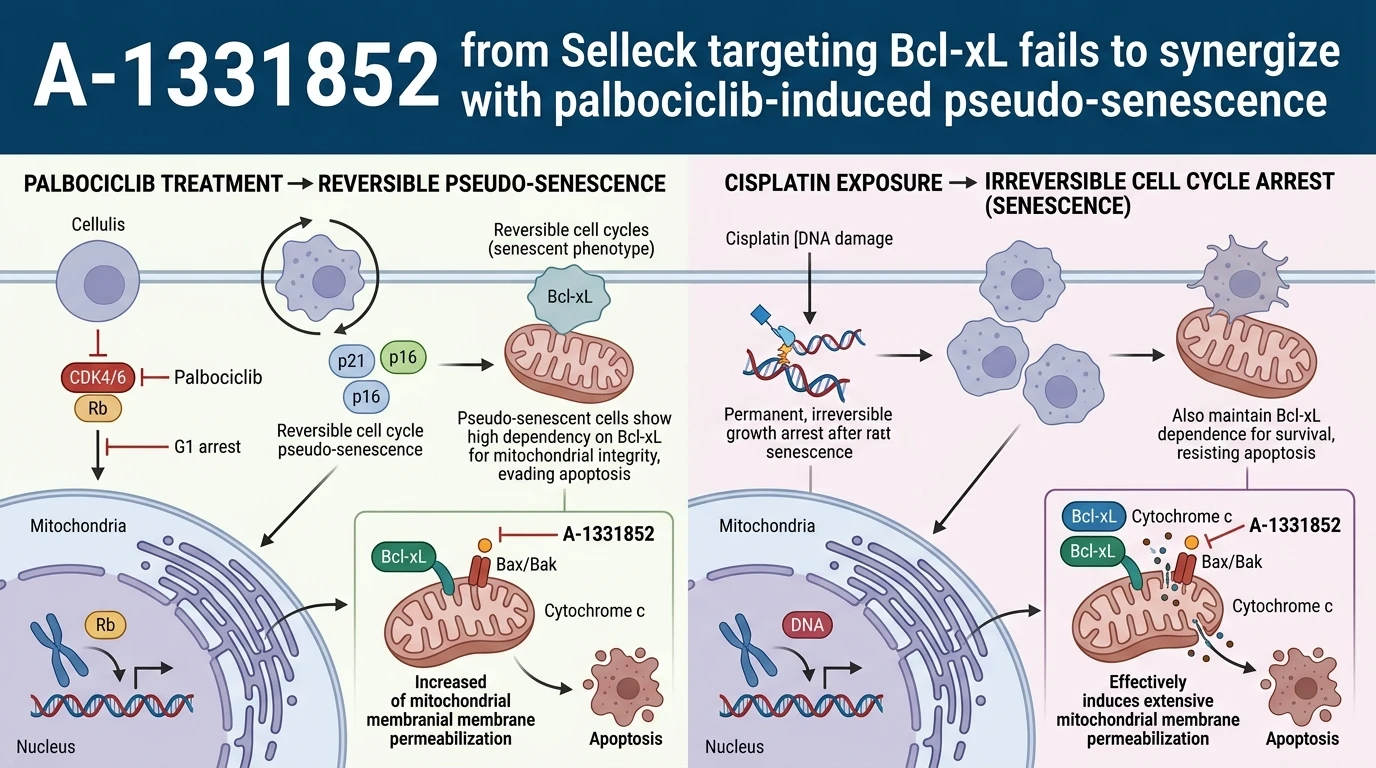
Targeting cellular senescence has emerged as a promising strategy in oncology, particularly through the concept of senolytic priming. In this therapeutic paradigm, pro-senescent agents force cancer cells into a state of stable growth arrest, during which survival becomes acutely dependent on anti-apoptotic Bcl-2 family network members. Subsequent administration of BH3 mimetics selectively eliminates these senescent cells. However, the fidelity of this approach depends on whether drug-induced cell cycle arrest reflects true terminal senescence or a transient, reversible state.
Pleural mesothelioma (PM) represents a recalcitrant thoracic malignancy characterized by resistance to conventional chemotherapy and limited secondary options. Inhibitors of cyclin-dependent kinases 4 and 6 (CDK4/6), such as palbociclib, effectively halt cell cycle progression in G1 by preventing RB1 phosphorylation. In PM cell models, exposure to palbociclib induces classical phenotypic features associated with senescence. Treated cells display marked enlargement, elevated senescence-associated beta-galactosidase (SA-β-Gal) activity, and increased secretion of pro-inflammatory cytokines comprising the senescence-associated secretory phenotype (SASP). Superficially, these morphological and biochemical shifts suggest successful establishment of a senescent state suitable for senolytic exploitation.
Despite these hallmarks, drug removal experiments reveal a distinct physiological reality. Upon wash-out of palbociclib, PM cells rapidly re-enter the cell cycle and resume active proliferation. This phenomenon defines a state of reversible pseudo-senescence rather than irreversible terminal arrest. Biochemical profiling demonstrates that CDK4/6 inhibition does not alter the underlying mitochondrial apoptotic threshold or create a selective vulnerability to anti-apoptotic protein suppression. Consequently, co-treatment or sequential administration of palbociclib alongside BH3 mimetics fails to produce synergistic cytotoxicity in PM cell panels.
To evaluate the efficacy of targeted Bcl-xL blockade in this setting, researchers investigated A-1331852, a potent, small-molecule BH3 mimetic designed to bind the hydrophobic groove of Bcl-xL with nanomolar affinity. The compound A-1331852 from Selleck served as a critical tool compound to dissect Bcl-xL dependency in PM models. When tested in combination with palbociclib, A-1331852 did not demonstrate enhanced killing in palbociclib-pretreated PM cells compared to vehicle controls. The lack of synergistic interaction extended to other BH3 mimetics, including navitoclax (ABT-263), indicating that CDK4/6 inhibitor-induced arrest does not reconfigure the Bcl-2 protein interactome in pleural mesothelioma.
Cytotoxicity assays revealed that sensitivity to A-1331852 was driven entirely by intrinsic baseline dependencies. Mesothelioma cell lines exhibiting high constitutive expression of Bcl-xL and low expression of redundant survival factors (such as MCL-1) displayed susceptibility to A-1331852 monotherapy regardless of prior palbociclib exposure. Conversely, lines lacking baseline Bcl-xL reliance remained refractory to A-1331852 even after acquiring palbociclib-induced senescent markers. Thus, palbociclib fails to prime PM cells for Bcl-xL-dependent senolysis.
In contrast to CDK4/6 inhibition, DNA-damaging chemotherapy exerts fundamentally distinct effects on cell fate. Exposure of PM cells to cisplatin results in persistent double-strand breaks, sustained p53 pathway activation, and irreversible cell cycle exit. Unlike palbociclib-treated populations, cisplatin-exposed PM cells do not resume division following drug withdrawal. This persistent senescent state correlates with sustained alterations in apoptotic priming, contrasting sharply with the pseudo-senescent phenotype induced by targeted CDK4/6 inhibition. Understanding these mechanistic divergence points is critical for designing valid senolytic combination strategies in thoracic oncology.
Pharmacological Characterization of Bcl-xL Inhibition in Mesothelioma Senescence
Copy code to add this image to your page
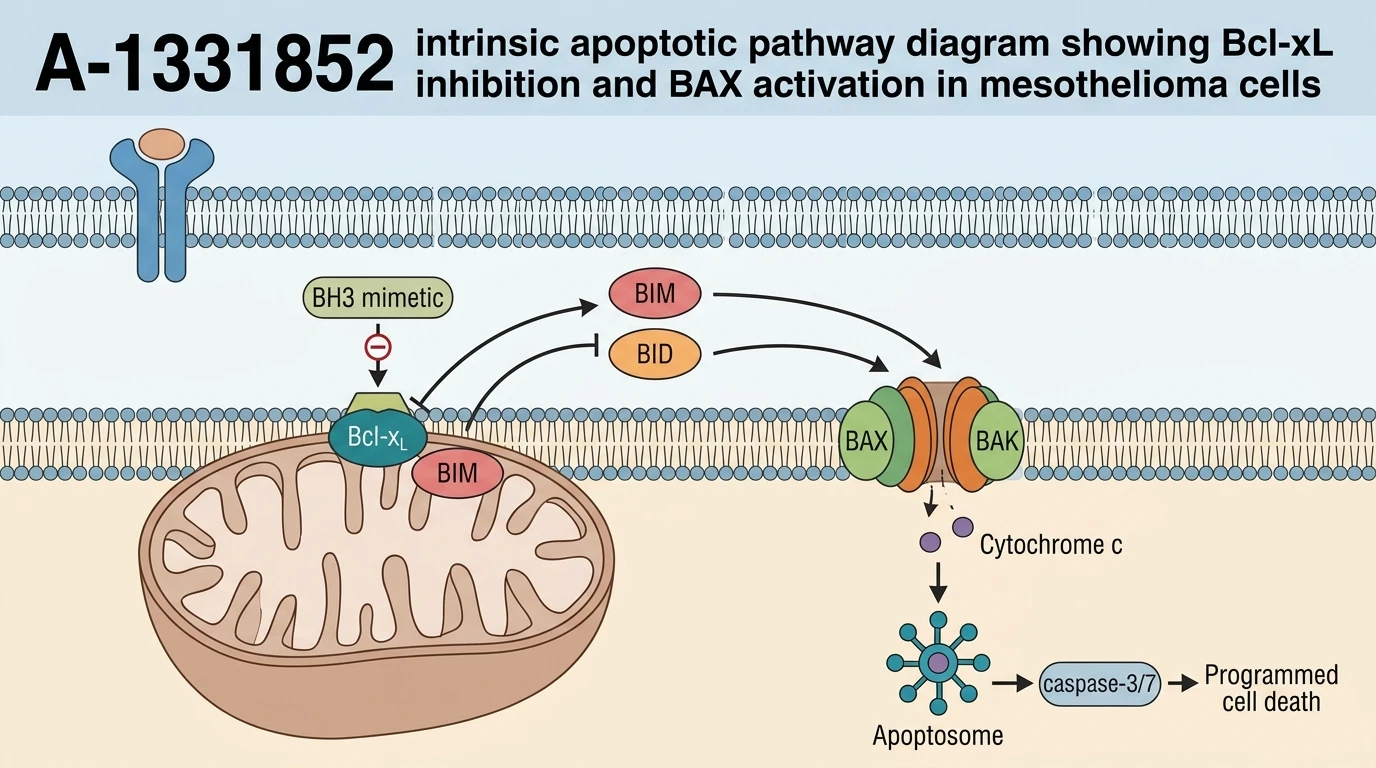
A-1331852 is a potent, highly selective small-molecule BH3 mimetic that targets Bcl-xL, disrupting its binding to pro-apoptotic factors like BIM. In pleural mesothelioma, CDK4/6 inhibition via palbociclib induces a state of reversible pseudo-senescence characterized by temporary cell cycle arrest without shift in Bcl-2 family dependencies. Because palbociclib does not alter mitochondrial apoptotic priming, combination therapy with A-1331852 lacks synergistic senolytic efficacy. Cellular sensitivity to A-1331852 remains governed exclusively by intrinsic baseline Bcl-xL dependency rather than palbociclib-induced arrest.
Palbociclib Sustains Reversible Arrest Without Senolytic Priming
Palbociclib treatment induced distinct physical markers in pleural mesothelioma cultures under tested in vitro assay conditions. Cell surface area expanded significantly. SA-β-Gal expression increased uniformly across treated populations. SASP cytokine accumulation was confirmed via immunoassay. Despite these classical features, cell cycle arrest remained strictly drug-dependent. Removal of palbociclib restored DNA synthesis within 48 hours. Proliferation rates matched untreated controls shortly thereafter. Furthermore, expression levels of anti-apoptotic proteins Bcl-xL, Bcl-2, and MCL-1 showed no uniform shifts toward apoptotic vulnerability. Co-incubation with the selective BH3 mimetic A-1331852 from Selleck yielded no excess lethality over predicted additive baseline values. The combination index values remained near unity across multiple dose ratios. These findings establish that palbociclib-induced pseudo-senescence does not alter mitochondrial apoptotic thresholds.
Baseline Bcl-xL Dependency Dictates Response to A-1331852
Univariate profiling demonstrated that baseline Bcl-xL expression directly correlates with monotherapy response. Mesothelioma lines harboring high Bcl-xL to MCL-1 ratios exhibited nanomolar sensitivity to A-1331852. Mitochondrial outer membrane permeabilization occurred rapidly upon drug addition in these sensitive lines. Cytochrome c release was documented within two hours of treatment. Conversely, cell lines with high baseline MCL-1 expression survived high concentrations of A-1331852. Palbociclib co-treatment failed to sensitize these resistant lines to A-1331852 from Selleck. The lack of senolytic enhancement indicates that CDK4/6 inhibition does not disrupt MCL-1 complexes or upregulate pro-apoptotic BIM. Consequently, therapeutic stratification must rely on pre-existing apoptotic dependencies rather than CDK4/6-induced phenotypic alterations.
Cisplatin Induces Persistent Senescence and Apoptotic Susceptibility
Genotoxic stress imposed by cisplatin produced distinct physiological outcomes compared to CDK4/6 blockade. Cisplatin-treated mesothelioma cells exhibited non-reversible cell cycle exit. Phosphorylated H2AX foci persisted indefinitely following drug removal. SA-β-Gal activity remained elevated without cell recovery. In this context of genuine terminal senescence, persistent DNA damage signaling lowered the apoptotic threshold. Mitochondrial priming metrics showed marked shifting toward pro-apoptotic readiness. These results highlight a fundamental divergence between targeted cytostatic agents and DNA-damaging regimens. Reversible pseudo-senescence induced by palbociclib lacks the persistent biochemical stress necessary to trigger dependency on Bcl-xL for survival.