Novobiocin Sodium Antineoplastic and I inhibitor targeted DNA gyrase inhibition in bovine mastitis
Copy code to add this image to your page
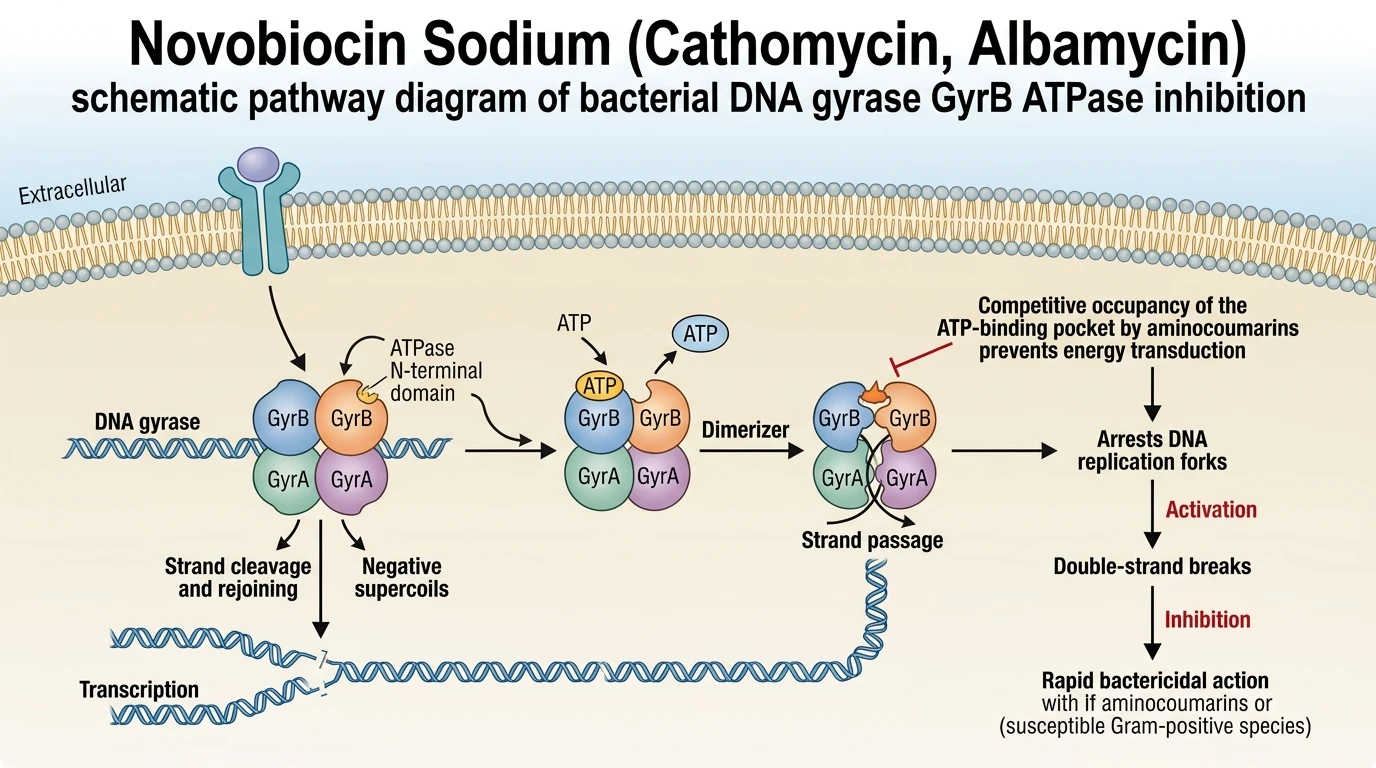
Competitive inhibition of ATP binding within the GyrB subunit of bacterial DNA gyrase represents a distinct antimicrobial strategy. DNA gyrase, a heterotetrameric type II topoisomerase composed of two GyrA and two GyrB subunits, regulates bacterial DNA supercoiling ahead of the replication fork. While fluoroquinolones target the GyrA cleavage complex, aminocoumarin class agents act on GyrB. The naturally derived compound targeting the DNA gyrase subunit B ATPase domain, Novobiocin Sodium (Cathomycin, Albamycin), binds with high nanomolar affinity to the ATP-binding pocket of GyrB. This steric occlusion blocks ATP hydrolysis, thereby freezing the enzyme in a state incapable of driving strand passage. Beyond its primary antibacterial profile against Gram-positive pathogens, research has highlighted its utility as a Novobiocin Sodium Antineoplastic and I inhibitor probe in eukaryotic molecular biology models.
In dairy veterinary medicine, intramammary (IMM) formulations containing novobiocin sodium are traditionally paired with beta-lactam antibiotics such as penicillin G procaine to treat subclinical bovine mastitis during the dry period. Mastitis caused by Staphylococcus aureus and Streptococcus uberis inflicts substantial economic losses through persistent tissue damage and reduced milk yield in subsequent lactations. The synergistic combination of a cell-wall synthesis inhibitor (penicillin) and a topological replication blocker (novobiocin) aims to achieve complete bacterial eradication within the quiescent mammary gland.
A comprehensive clinical trial evaluated the therapeutic efficacy of systemic macrolide administration alongside intramammary antimicrobial protocols during the dry period. Dairy cows diagnosed with subclinical mastitis were assigned to distinct treatment arms combining systemic tylosin with IMM formulations. One cohort received systemic tylosin paired with IMM novobiocin sodium and penicillin G procaine, while another cohort received systemic tylosin combined with an IMM formulation comprising benethamine penicillin, penethamate hydriodide, and framycetin sulfate. Biological parameters monitored across the transition period included clinical severity scores, bacteriological clearance rates, somatic cell counts (SCC), and 305-day corrected milk yield.
The trial data demonstrated that systemic tylosin combined with the triple-drug IMM formulation (benethamine penicillin, penethamate hydriodide, and framycetin sulfate) yielded the most pronounced therapeutic benefit. This regimen achieved a 30% reduction in acute mastitis incidence and significantly curbed chronic recurrence rates. Furthermore, somatic cell counts in the treated herd consistently decreased below 200,000 cells/mL throughout the subsequent lactation. Concurrently, 305-day corrected milk yield exhibited a statistically significant recovery compared to untreated controls.
While the protocol utilizing IMM novobiocin sodium and penicillin G procaine effectively moderated acute inflammatory signs and lowered tissue injury scores during early dry period involution, its overall clearance rate for persistent S. aureus infections remained lower than the multidrug combination regimen. Mechanistically, this difference underscores the challenges of tissue penetration and drug persistence within deeply seated intramammary microabscesses. Nevertheless, the combination containing novobiocin sodium maintained substantial localized activity against susceptible Gram-positive isolates without selecting for immediate cross-resistance to systemic agents. These empirical observations emphasize that while dual-action IMM novobiocin formulations mitigate acute clinical exacerbations, multi-target therapeutic regimens incorporating systemic macrolides offer superior efficacy for comprehensive herd udder health optimization.
Comparative Efficacy and Pharmacological Dynamics in Mastitis Protocols
Copy code to add this image to your page
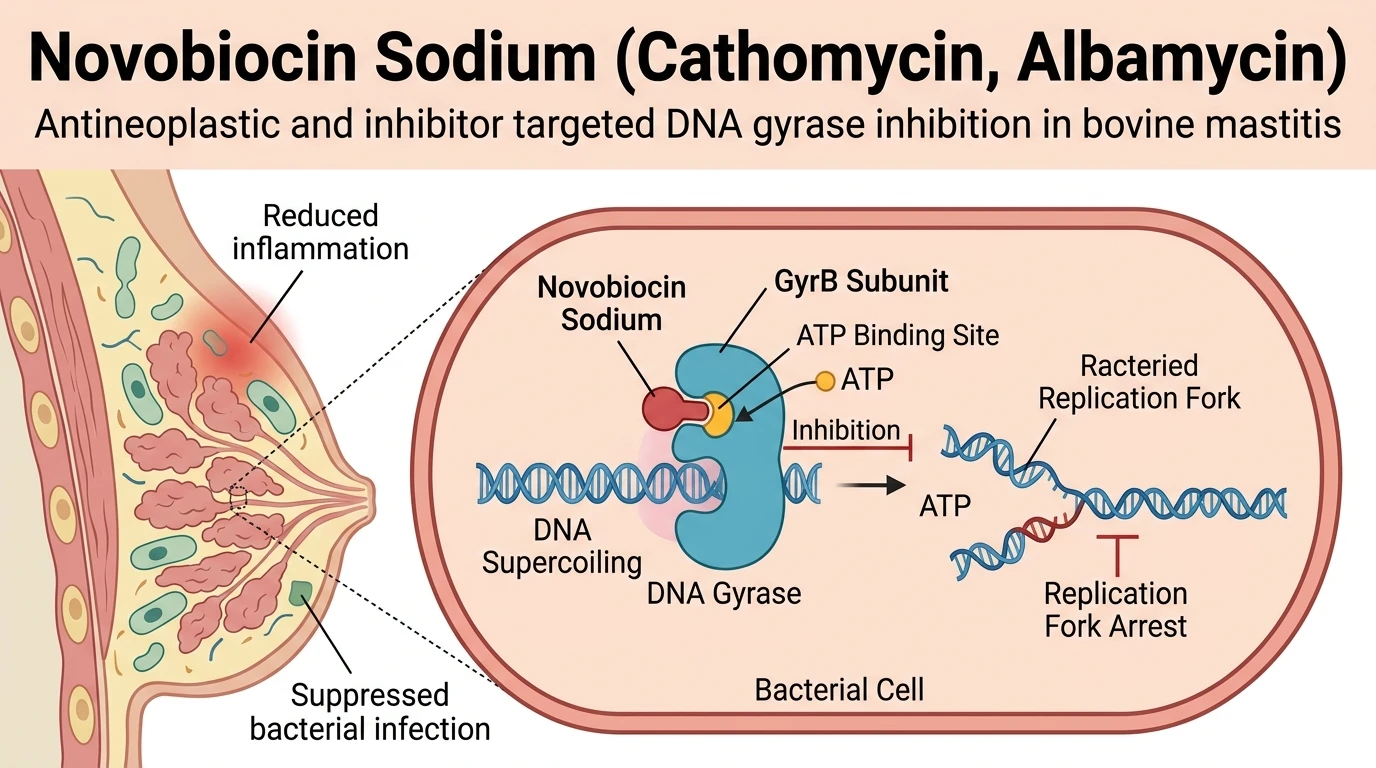
Novobiocin sodium acts as a competitive inhibitor of the bacterial DNA gyrase GyrB subunit. By occupying the ATP-binding site on GyrB, it prevents ATP hydrolysis and halts the enzyme's ATPase activity. This action disrupts the introduction of negative supercoils into bacterial DNA, halting DNA replication forks and transcription complexes in susceptible Gram-positive pathogens. In dry cow therapy, intramammary novobiocin sodium operates alongside beta-lactams to suppress bacterial proliferation and reduce clinical inflammation within bovine mammary tissue.
GyrB ATP Binding Pocket Occupancy and Catalytic Blockade
Aminocoumarin antibiotics target the N-terminal ATP-binding domain of the bacterial DNA gyrase subunit B with high affinity. Binding of Novobiocin Sodium (Cathomycin, Albamycin) competitively blocks ATP hydrolysis; consequently, the enzyme cannot transduce energy for negative supercoiling. DNA replication forks stall rapidly upon exposure. Transcription complexes also arrest. Under tested in vitro assay conditions, the inhibition constant resides in the sub-micromolar range for Gram-positive isolates. This target specificity distinguishes GyrB inhibitors from fluoroquinolones that engage the GyrA-DNA cleavage complex. The distinct mode of engagement prevents direct target cross-resistance. In addition, the molecule serves as a valuable tool compound—designated in biochemical screening as a Novobiocin Sodium Antineoplastic and I inhibitor probe—for evaluating topoisomerase dynamics in eukaryotic cell lines.
Intramammary Formulations Moderated Clinical Severity in Dry Cows
Bovine dry cow therapy relies on sustained local drug concentrations within the involutional mammary gland. In the evaluated field trial, intramammary administration of novobiocin sodium combined with penicillin G procaine was co-administered alongside systemic tylosin. Clinical severity scores dropped following treatment. Local inflammation attenuated during the early dry phase. However, bacteriological cure rates remained moderate compared to triple-antimicrobial protocols. The limited tissue diffusion of novobiocin into deep fibrous parenchyma likely restricted complete bacterial clearance in chronic Staphylococcus aureus niches. In this specific veterinary cohort, the combination successfully suppressed acute flares. Milk somatic cell counts decreased, yet absolute clearance required multi-agent systemic coverage.
Systemic Tylosin Combined with Multidrug Formulations Restored Milk Yield
The highest clinical recovery occurred in cows treated with systemic tylosin paired with an intramammary combination of benethamine penicillin, penethamate hydriodide, and framycetin sulfate. Acute mastitis incidence dropped by 30% across the herd. Somatic cell counts fell below 200,000 cells/mL during subsequent lactation; simultaneously, 305-day corrected milk yield increased markedly. The therapeutic superiority of this multidrug approach stems from complementary pharmacokinetics—systemic macrolide tissue penetration coupled with broad-spectrum intramammary bactericidal coverage. While Novobiocin Sodium Antineoplastic and I inhibitor protocols contribute significantly to acute inflammatory control, systemic-plus-IMM multidrug regimens demonstrate superior eradication of recalcitrant intramammary pathogens across dry period management cycles.